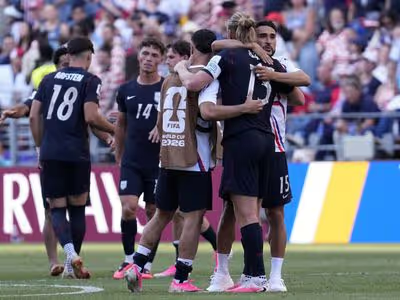
The 2026 World Cup has turned national identity into a live debate: Morocco’s largely foreign‑born squad, racist abuse aimed at Dutch players after a shootout, and a multicultural U.S. team competing while restrictive immigration policies bite show how migration, colonial history and politics are playing out on football’s biggest stage.
World Cup exposes contradictions in national identity
The tournament has made one of football’s oldest truths painfully clear: national teams are mirrors of migration, colonial history and diaspora, not fixed ethnic blueprints. Morocco’s squad, European national teams with large diasporas, and the United States’ multi‑heritage roster have all turned international football into a contest over who counts as “us.”
Morocco: a team shaped by migration and history
Morocco named a squad in which the majority of players were born outside the country, many in France and Spain. That reality is not an anomaly but a product of migration patterns, colonial ties and modern scouting that reaches diasporas across Europe. Morocco’s success on the pitch crystallizes how national representation now often relies on talent developed abroad.
European teams: diversity amid political debate
France, England, Germany, Belgium, the Netherlands and the Netherlands’ opponents at the World Cup all showcase squads with significant numbers of players from immigrant families. Those teams illustrate a paradox: countries wrestling with exclusionary political narratives are fielding multicultural XIs on the global stage. When success arrives, integration narratives get airtime; when defeat comes, minority players can quickly become targets.
Incidents that stripped away the gloss
The tournament’s drama has included ugly reminders of how fragile acceptance can be. After the Netherlands were eliminated by Morocco in a penalty shootout, three Black Dutch players who missed spot kicks were subjected to racist abuse online. The episode highlighted a recurring pattern: players celebrated as national heroes when they win can be turned into outsiders when they fail.
The U.S. contradiction: multicultural team, restrictive policies
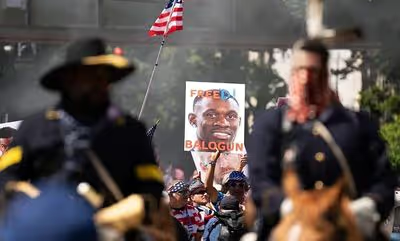
As a co‑host, the United States presented perhaps the clearest contradiction. The U.S. squad featured several foreign‑born players and multiple dual nationals — including forwards Folarin Balogun, Alejandro Zendejas and Haji Wright — yet the host country has implemented restrictive immigration measures and tightened refugee and entry policies. Incidents at the tournament underlined the tension: an internationally recognized referee was denied entry, the Iranian team faced travel restrictions, and an arriving Iraq striker was detained and delayed.
Why this matters beyond the scoreline
Teams are living evidence that national identity evolves through migration and historical ties. For fans and politicians, football’s emotional power gives these shifts visibility and force. That visibility can push public conversations toward inclusion — or sharpen backlash from nationalist constituencies unsettled by change.
Sporting consequences and social impact
From a sporting perspective, tapping into diasporas has widened talent pools and diversified playing styles. Federations that embrace dual‑nationals and foreign‑born players often gain tactical variety and depth. Socially, however, the presence of visible minorities in national teams becomes a lightning rod for debates about belonging, race and historical responsibility.
What could happen next
Football governing bodies, national federations and clubs will need to manage two parallel challenges: protecting players from abuse and ensuring fair access to the game for diverse communities.
Expect increased investment in education campaigns, clearer anti‑racism enforcement, and more public discussion about citizenship rules and talent identification.
Political actors may try to exploit moments of national feeling, but the reality on the pitch makes it harder to sustain simplistic narratives about who belongs.
Final takeaway
The 2026 World Cup has done more than crown a champion or produce stories of brilliance and heartbreak. It has held up national teams as living case studies of modern identity — messy, transnational and often at odds with political rhetoric.
Belgium routs USA 4-1 amid Balogun eligibility drama and Trump intervention
For football lovers and policymakers alike, the tournament’s most enduring lesson may be that national identity is contested, adaptive, and increasingly reflected on the pitch.
 Al Jazeera