
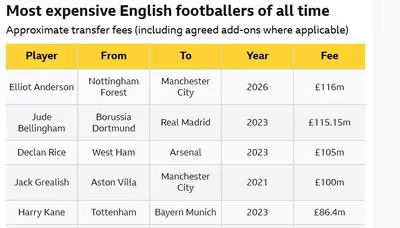
Elliot Anderson is set to become the most expensive British player in history after Manchester City agreed a record-breaking £116m move with Nottingham Forest, eclipsing previous marks. The 23-year-old midfielder's blend of ball-winning, progressive passing and relentless engine convinced City to pay a premium; formalities will follow once his World Cup commitments conclude.
Manchester City sign Elliot Anderson in British-record transfer
Elliot Anderson’s transfer to Manchester City for around £116m tops the domestic market and resets expectations for English midfielders. City have negotiated the deal with Nottingham Forest and will finalise paperwork after Anderson completes his World Cup duties. The headline fee reflects not just market inflation but a specific tactical fit: a midfielder who wins the ball, progresses play and sustains rare physical output.
Why City shelled out a record fee
City’s purchase is less about glamour and more about solving midfield problems in the post-Pep era. Anderson’s statistical profile—3,300 touches, 2,038 completed passes and 376 line-breaking passes last season—marks him as a central connector who can both retain and advance possession. He led the Premier League for duels won (298), possessions won (306) and fouls won (80), showcasing a rare combination of aggression and control.
Value beyond goals and assists
Anderson’s four goals and four assists understate his creative influence: he created 54 chances, including nine big chances, and recorded 4.8 expected assists. Those numbers matter because City require midfielders who can break defensive lines and manufacture opportunities in tight, possession-heavy games. His progressive passing and line-breaking tendencies align with a side that expects to probe and unlock opponents consistently.
Physical profile: endurance and intensity
Anderson’s athletic output is a major part of the recruitment case. He covered 411km in the Premier League season—among the highest for midfielders—and delivered 1,895 high-intensity pressures, ranking him near the summit of the division. Availability is part of his value: Anderson started 37 league matches, missing only one due to rotation. For a club that demands relentless pressing and turnover recovery, those attributes are invaluable.
Performing in a chaotic Forest environment
That Anderson produced these metrics while Nottingham Forest changed managers multiple times is significant. Forest often operated from transitional positions rather than prolonged dominance, so Anderson was repeatedly tasked with defending large spaces and converting defence to attack. Producing elite progressive numbers in that context suggests his output was driven by individual capacity rather than system-driven profiteering.
What this means for Nottingham Forest
Forest face a sizeable replacement task. Anderson was central to their midfield structure; his departure leaves both a tactical and leadership void. The club will likely pursue at least two recruits—a deep-lying number six and a dynamic number eight—to replicate his blend of recovery, progression and creativity. Names linked as possibilities include Davide Frattesi and Lucas Bergvall, indicating Forest will target players capable of high-intensity recovery and forward passing.
How Anderson fits into Enzo Maresca’s Manchester City
Anderson arrives as City transition from Pep Guardiola to Enzo Maresca. Maresca’s midfield blueprint—aggressive ball recovery, high pressing and rapid vertical transitions—mirrors Anderson’s strengths. Under Maresca at Chelsea, midfielders were valued for high-intensity pressures and forward line-breaking passes; Anderson’s metrics match that profile and suggest he can be a ready-made cornerstone for the new regime.
Likely role and partnerships
City are expected to slot Anderson into a central role alongside Rodri, aiming for balance between protection and forward momentum. Rodri’s control and Anderson’s forward thrust would create a complementary pairing: one to hold and distribute, the other to press higher and break lines. That said, squad fitness, tournament aftermaths and tactical tuning could dictate alternative partners or minor role adjustments as Maresca defines his first full season.
Big-money transfers and the pressure to deliver
Record fees inevitably bring intense scrutiny. The concern for City is not whether Anderson can produce in isolation but whether he can translate his Forest performance into a side that dominates possession and demands different decision-making rhythms. History shows players with high-intensity, ball-winning profiles can flourish in possession-heavy teams—but the margin for tactical and technical refinement is slim at an elite club.
Short-term outlook and next steps
Immediate priorities: complete transfer formalities post-World Cup, integrate Anderson into pre-season and align his role with Maresca’s pressing patterns. For Forest, sale proceeds must be reinvested thoughtfully to cover both the midfield engine and squad depth. For City, the measure of success will be how quickly Anderson adjusts to possession-first demands and whether he can be the midfield fulcrum in a new managerial era.
Conclusion
This deal is more than a blockbuster fee; it’s a strategic acquisition that signals Manchester City’s intent to find a new midfield identity under Enzo Maresca. Elliot Anderson brings a rare mix of volume, intensity and progressive passing that explains the price tag.
The coming months will determine if that blend can be refined into the consistent, possession-oriented excellence City requires—if it can, the fee will feel justified; if not, the spotlight will be unforgiving.
 The Bbc