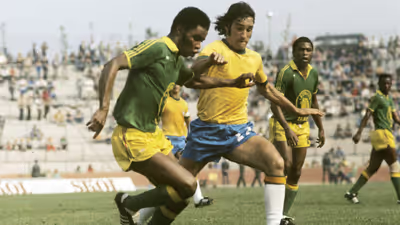
The 1974 World Cup was less a sport tournament than a global stage for political theatre: Zaire's squad reportedly threatened by Mobutu, an East vs West Germany showdown amid the Cold War, and a boycotted Chile–USSR playoff that left a stadium empty — events that permanently blurred the line between football and state power.
1974 World Cup: politics eclipses the beautiful game
The 1974 World Cup in West Germany is remembered as much for geopolitics as for goals. From Zaire’s harrowing experience under Mobutu Sese Seko to the surreal East Germany–West Germany encounter and the Chile–Soviet boycott, the tournament became an arena where authoritarianism, Cold War rivalries and human rights crises played out on the pitch.
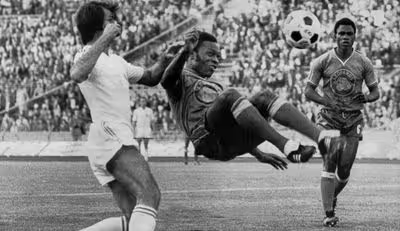
Zaire in 1974: fear, strikes and a desperate act on the pitch
Zaire’s qualification as the first Sub-Saharan African nation at a World Cup carried historic promise — and dangerous politics. Mobutu framed the squad as national symbols, repatriating players and promising rewards tied to on-field results. That dynamic quickly turned toxic after a heavy 9-0 defeat to Yugoslavia and mounting threats about unpaid bonuses.
Ilunga Mwepu’s run: a moment misread for decades
With Brazil leading 3-0, defender Ilunga Mwepu sprinted out of the wall and kicked away a free kick before the whistle. The act was mocked for years as ignorance. The fuller context is chilling: Mwepu later said the team faced threats that their safety — and their families’ — would be at risk if they lost by more than three goals. His attempted red-card provocation should be read as a desperate bid to avoid returning home under threat, not a naïve mistake.
Why Zaire matters today
Zaire’s World Cup experience exposed how fragile national sports projects can become when tied to autocratic prestige. The episode dented Mobutu’s sporting ambitions and, embarrassingly for his regime, he soon pivoted to staging the Rumble in the Jungle to reclaim international attention — underscoring how sport and spectacle can be manipulated for political redemption.
The Cold War on grass: East Germany’s iconic victory
One of the tournament’s most emblematic matches pitched East Germany against West Germany, two footballing systems split by ideology and separated leagues. East Germany’s 1-0 win — Jürgen Sparwasser’s famous strike — was more than an upset; it was a symbolic victory in a year when the Iron Curtain’s divisions played out under stadium lights.
Sport as soft power
That single match crystallized the political stakes of international football. For East Germany it was propaganda proof of international competitiveness; for West Germany the broader tournament still ended in triumph, but the result remains a reminder that national narratives are woven into sporting outcomes.
Chile vs USSR: a match that never truly happened
After Pinochet’s coup in 1973, Chile’s Estadio Nacional doubled as a detention center. When the Soviet Union refused to play the return leg of a World Cup qualifier there, FIFA officials inspected the venue and cleared it. The Soviets boycotted; Chile took the field and rolled the ball into an empty net, earning a symbolic 2-0 win and qualification.
The moral fallout and FIFA’s role
That episode raised enduring questions about governing bodies and human rights. Allowing a match at a site linked to political imprisonment and torture — or treating the resulting walkover as routine sport administration — illustrated a troubling separation between football governance and ethical responsibility.
Legacy and lessons: when football reflects the world’s fractures
The 1974 World Cup serves as a case study in how sport cannot be isolated from politics. It revealed how authoritarian leaders exploit football for legitimacy, how Cold War rivalries gain new theatres, and how international bodies can be tested by geopolitical crises.
What it means for modern football
These stories are not mere historical curiosities. They shape how federations, players and fans view the sport’s ethical boundaries today. The events of 1974 press modern football stakeholders to consider accountability, player welfare and the diplomatic weight that major tournaments carry.
Conclusion: lasting images, enduring questions
From Ilunga Mwepu’s desperate run to Sparwasser’s celebrated goal and the empty Estadio Nacional, the 1974 World Cup left indelible images that transcend scoresheets. The tournament’s politics forced football into a mirror: spectacular, contested and unavoidably political.
Former England star has bold prediction for how far USMNT will go at 2026 World Cup
Future tournaments will continue to test whether football can be a force for global unity or merely a stage for statecraft.
 Cbssports