Curacao has become the smallest nation ever to qualify for the FIFA World Cup, capping an unbeaten CONCACAF campaign that began with Patrick Kluivert’s 2015 overhaul and a successful dual-national recruitment strategy. The Blue Wave’s rise reshapes regional expectations, even as last-minute coaching upheaval leaves preparation for a brutal 2026 group uncertain.
Curacao's historic World Cup qualification — what happened
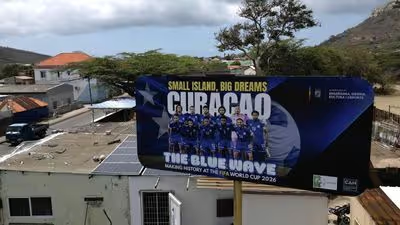
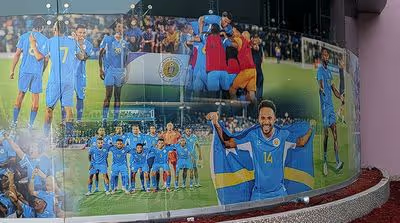
Curacao sealed World Cup qualification with a 0-0 draw against Jamaica, completing an unbeaten CONCACAF campaign and earning a place at FIFA World Cup 2026 in the United States, Mexico and Canada. This makes Curacao the smallest nation by population to reach a World Cup, a milestone with immediate sporting and cultural impact.
Why this matters
Curacao’s breakthrough rewrites the CONCACAF pecking order and validates a recruitment model that pairs the island’s local talent with professional dual-nationals from the Netherlands. For a federation of about 158,000 people, qualification brings global attention, sponsorship potential, and an urgent demand to convert short-term success into long-term infrastructure and youth development.
The Kluivert pivot: how a one-year tenure changed everything
Patrick Kluivert’s brief 2015–16 stint as coach is the hinge of Curacao’s modern project. He pushed hard to recruit professionals from Dutch leagues and staged a defining 2016 friendly that exposed the gap between island-based players and those playing abroad — a 7-1 result that ended local resistance to recruiting dual-nationals. That tactical shift set the template for Curacao’s rise from regional also-ran to World Cup qualifier.
Dual-national recruitment: the engine of the Blue Wave
Goalkeeper Eloy Room and forwards like Jurgen Locadia are emblematic of the dual-national strategy. Room, now among Curacao’s most-capped players, calls the decision to commit “a journey,” and Locadia says qualification will make similar switches easier for others. This approach mirrors successful models in Morocco, Suriname and Cape Verde — countries that combined diaspora talent with homegrown players to outperform expectations on the global stage.
Island context: identity, history and the emotional lift
Curacao’s relationship with the Netherlands is layered and historical, rooted in colonial ties that still influence culture and sport. That made the early debate over Dutch-born players politically charged. Now, the squad’s open engagement with local fans — from training-ground visits to intimate community interactions — has softened opposition and turned the team into a unifying national symbol. Supporters celebrated qualification in the streets of Willemstad; for many locals, simply reaching the World Cup feels like a victory in itself.
Sporting ripple effects beyond soccer
Baseball once dominated Curacao’s sporting identity, with island-born stars representing the Netherlands. Soccer’s ascent now gives the island its own national platform, and Curacao plans to compete independently in other events, such as the World Baseball Classic. The World Cup qualification accelerates commercial interest and could drive investment in facilities like the Ergilio Hato Stadium.
Coaching turbulence and what it means for tournament readiness
Curacao’s managerial path has been bumpy. Dick Advocaat led the team through qualification but stepped down for personal reasons; Fred Rutten was appointed and then resigned shortly before the tournament. Advocaat has since returned, meaning a 78‑year‑old manager will lead the squad into the World Cup — a development that brings both experience and questions about continuity. Players reportedly challenged Rutten’s tactics after poor March results, and the late change forces a compressed preparation window ahead of a demanding group.
Practical risk versus upside
A coaching switch so close to the tournament risks tactical confusion and disrupted routines. The counterargument is practical: Advocaat’s experience could steady a squad entering the global stage for the first time. The staff must now prioritize clarity in roles, match plans, and fitness rather than wholesale philosophical shifts.
The World Cup group and realistic objectives
Curacao drew a daunting group that includes Germany, Ivory Coast and Ecuador. Immediate goals are clear and modest: compete with discipline, target one positive result, and use the tournament to raise the profile of Curacao football. FFK leadership frames Germany as a must-not-lose opener — a pragmatic stance aimed at managing expectations while chasing a historic upset.
What success looks like
A win or draw would be seismic for the island and could catalyze long-term growth. Even competitive performances against heavyweight nations would validate the dual-national model and increase the bargaining power of Curacao within CONCACAF and global sponsorship markets.
Legacy planning: turning a one-off into sustainable progress
Qualification is stage one. To sustain success, Curacao needs improved youth development, better facilities, and a pathway that produces more island-born players in future squads. Recent stadium renovations and rising sponsor interest are positives, but governance and investment must follow. Eloy Room and others see World Cup exposure as a lever to attract resources; the federation’s challenge is to convert attention into infrastructure and coaching at the grassroots.
Looking toward 2030
If Curacao wants to compete for another World Cup in 2030, it must balance diaspora recruitment with a deliberate strategy to cultivate local talent. That dual approach is not mutually exclusive — it’s how small nations can scale without losing identity.
Final take: a historic achievement with hard choices ahead
Curacao’s World Cup berth is a triumph of strategic recruitment, charismatic leadership moments, and island-wide belief. The Blue Wave has given the country a global stage and an opportunity to professionalize football at home.
What New Jersey fans need to know about the FIFA World Cup
Now comes the harder work: steady coaching, investment in youth, and smart stewardship of the moment so that 2026 becomes the opening chapter of a sustained sporting rise rather than a celebrated one-off.
 Cbssports