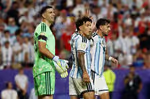
Jurgen Klopp has publicly backed the World Cup’s mandatory mid-half hydration breaks, siding with FIFA’s welfare and fairness argument despite fan backlash. The pauses — enforced every half for roughly three minutes — have drawn criticism over game flow and perceived commercial motives, while UEFA says it won’t adopt blanket breaks at the European Championship unless heat thresholds demand them. The debate exposes a clash between player safety, coaching influence and fan appetite for uninterrupted football.
Klopp backs World Cup hydration breaks amid fan backlash
Jurgen Klopp, the former Liverpool manager known for plain-speaking pragmatism, has defended the World Cup’s new mandatory hydration breaks. Klopp acknowledged the pauses are longer than necessary for a quick drink, but framed them as helpful for players and a welcome respite for coaches and staff.

Klopp’s endorsement comes as sections of the fanbase accuse tournament organisers of altering the rhythm of matches — and of opening space for additional advertising — by institutionalising stoppages.
How the breaks work
Matches at this World Cup have been stopped midway through each half for roughly three minutes, allowing players to rehydrate and managers to give instructions. Traditionally, water breaks were used only when temperatures exceeded specific limits; this edition applies them uniformly to every match.
Organisers say the consistent approach guarantees all teams face the same conditions regardless of stadium climate control or local weather.
Why fans are frustrated
Supporters argue the enforced pauses interrupt momentum, undermine the flow that makes football compelling, and feel engineered to create commercial inventory. Those complaints are amplified on social media and among purists who view frequent stoppages as a step toward broadcast-friendly, rather than sport-first, scheduling.
There is also visible frustration when stadiums with air conditioning see the same breaks as open-air venues, feeding the perception of inconsistency.
FIFA’s defence: welfare and equality across fixtures
FIFA president Gianni Infantino has defended the policy as both a player welfare measure and a fairness mechanism. Infantino stresses that over a condensed tournament — cited at 39 days with teams potentially playing up to eight matches — scheduled rest moments can reduce heat-related risk and ensure every coach has the same opportunity to make adjustments.
That fairness argument is central: by standardising breaks, FIFA aims to remove environmental variance as a tactical advantage between matches.
UEFA’s contrasting stance
UEFA has already indicated it will not mandate hydration breaks at the European Championship unless temperatures surpass a defined threshold. That position underscores a more conservative approach: use breaks as needed rather than as a blanket rule.
The divergence between governing bodies creates a patchwork of practice across elite tournaments, which increases debate about where the balance should lie between player care and preserving match authenticity.
What this means for teams, managers and the sport
For players, regular pauses reduce immediate heat stress and offer predictable recovery windows. For managers, a scheduled stoppage creates a structured moment to influence the game — which can be seen as legitimate coaching or an unwanted tactical reset, depending on perspective.
For the sport, the row highlights a deeper tension: who decides acceptable interruptions — organisers prioritising safety and commercial realities, or fans and traditionalists defending uninterrupted play?
What could change next
Expect governing bodies to refine thresholds and transparency around when and why breaks are used. Temperature-based criteria, clearer medical justifications and limits on their length would be a logical compromise. UEFA’s selective approach may push FIFA to justify blanket application more rigorously or adopt a temperature-triggered model in future editions.
Ultimately, ongoing feedback from players, coaches and supporters will shape whether mandatory mid-half breaks become standard, are limited to extreme conditions, or are further adjusted to protect the sport’s pace.
Bottom line
The hydration-break controversy is less about a single pause in play and more about competing priorities: player welfare, coaching influence, broadcast economics and fan experience.
MetLife to host World Cup 2026 final on July 19 — football meets halftime spectacle
Klopp’s support lends weight to the welfare argument, but governing bodies will need clearer, consistent criteria to resolve the credibility gap with supporters and preserve the integrity of elite competition.
 Express