Breaking: The US-hosted World Cup opens under a cloud: FIFA president Gianni Infantino’s public coziness with Donald Trump, the denial of entry to Somalia’s top referee, and unprecedented travel restrictions on Iran have combined with soaring ticket prices and protests to make governance and fairness the story — not the pitch. Players now carry the tournament’s redemption burden as organizers face mounting criticism and logistical chaos.
FIFA leadership and political entanglement set an uneasy tone
Gianni Infantino’s public embrace of President Donald Trump has become more than optics; it’s a fault line for a tournament that promised global unity. Infantino’s high-profile gestures — including a bespoke award and repeated praise of US authorities — feed a narrative that FIFA’s priorities have skewed toward political access and commercial advantage.
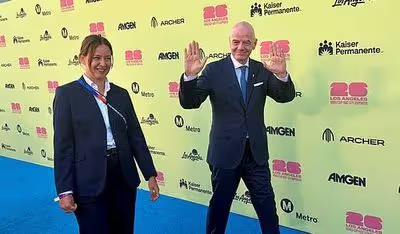
That alignment matters because it frames how decisions are made and whose interests are protected when diplomatic tensions arise.
What Infantino’s approach signals
Infantino’s pragmatism reads as transactional: steer FIFA toward the deepest pockets and the most powerful allies, then manage the fallout. That approach may secure short-term gains — record revenue and political cover — but it also risks eroding FIFA’s claim to be a neutral steward of the game, especially when administrative decisions intersect with travel bans, border enforcement and human-rights concerns.
Travel bans and exclusions escalate controversy
The most tangible symptom of the political friction has been travel control. Omar Artan, Somalia’s elite referee and Africa’s top official last year, was denied entry to the United States after hours of questioning and returned to Istanbul — eliminated before the tournament began. He was reportedly on FIFA’s final refereeing list, which underscores the severity of the breach: an official cleared by football’s governing body was blocked by immigration policy.
Iran’s unprecedented match-day restrictions
Iran’s national team faces an extraordinary constraint: it cannot remain overnight in the US for any of its games and must travel in and out on match days. The team relocated its training base to Tijuana, Mexico. Those conditions don’t just complicate logistics; they create a competitive and psychological disadvantage, puncturing the long-held fiction that politics and sport can be neatly separated.
Fans and officials feel the pinch of commercial choices
Ticket prices and venue policies have compounded public frustration. Sky-high costs and early bans — like the initial restriction on reusable water bottles, later rolled back after public outcry — highlight a tournament calibrated to revenue and brand partners. Analysts estimate FIFA will generate near-record income this year, redistributing a substantial sum to associations worldwide. That windfall underscores why leadership may prioritize financial outcomes, but it deepens the gulf with supporters who feel priced out and sidelined.
Protests, transport disruptions and local unrest
Mexico City’s opening-week atmosphere has been tense. Planned demonstrations by human-rights groups, students, teachers and local residents converged near Estadio Azteca, prompting temporary station closures and transit warnings. Those actions reflect broader grievances — from disappearances tied to organized crime to concerns about public spending and displacement — and they ensure the tournament will be contested not only on the field but in the court of public opinion.
Sporting stakes: can the players save the spectacle?
Despite the governance and logistical chaos, the tournament retains its core competitive promise. The expanded 48-team format and 104 matches create a longer, messier build-up but may deliver more drama in knockout stages. The onus of redemption falls on players: Lionel Messi, Kylian Mbappé, Harry Kane, Vinícius Júnior, Lamine Yamal, Erling Haaland, Mohamed Salah and others can reclaim the narrative with compelling performances.
Who to watch and why it matters
The field looks open. Traditional heavyweights — Argentina, Brazil, France, Spain, Portugal, England — still dominate conversations, but no clear single favorite stands head and shoulders above the rest. Emerging talents and the health of key players (Lamine Yamal’s hamstring will be watched closely) could tilt the balance. If the football delivers intensity and unpredictability, it will blunt some criticism and restore the tournament’s spectacle.
What comes next: accountability, optics and institutional risk
This World Cup’s opening days will test FIFA’s crisis management and the US hosts’ ability to separate immigration policy from sporting fairness. Expect continued scrutiny over denied entries, travel conditions for national teams and the handling of protests. For FIFA, the bigger risk is reputational; short-term financial success cannot erase governance questions that may shape leadership contests and reform debates.
Verdict — sport can redeem, but reform is needed
On the field, football still has the power to captivate and to drown out off-field controversies when the quality is high. But meaningful redemption for this tournament requires more than great goals and dramatic knockout ties: it needs clearer governance, consistent treatment of teams and officials regardless of geopolitics, and policies that prioritize access for fans.
A Beginner's Guide to the 2026 World Cup
Until then, the World Cup’s story will be equal parts spectacle and cautionary tale.
 Mail Online