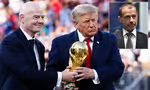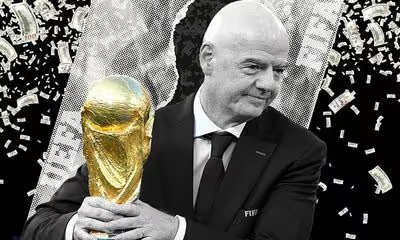
UEFA and Concacaf have launched a united rebuke of FIFA president Gianni Infantino’s proposal to bring private investment into the World Cup, with UEFA warning it could boycott FIFA competitions unless plans are abandoned. The move exposes a deep governance rift at football’s summit and raises the prospect of a prolonged power struggle ahead of FIFA’s 2027 congress in Morocco.
Breaking: UEFA threatens World Cup boycott over Infantino’s privatization plan
UEFA’s 55 member associations issued a unanimous condemnation of Gianni Infantino’s proposal to introduce large-scale private investment into the World Cup structure, declaring “the World Cup is not for sale.”
Concacaf’s membership echoed the stance, amplifying pressure on FIFA and signalling a coordinated challenge from football’s largest confederations.
What UEFA and Concacaf are saying
UEFA leader Aleksander Ceferin framed the plan as a governance failure, accusing FIFA’s leadership of pushing proposals without meaningful consultation. The confederation called the move “irresponsible and indefensible,” and warned that participation in FIFA competitions, including the World Cup, could be withdrawn unless the proposals are scrapped.
What Infantino proposed
FIFA under Gianni Infantino has explored raising private capital—reported in public debate as a multi-billion-pound investment—to commercialize aspects of the World Cup and related rights. FIFA argues such funding could secure long-term investment in the sport and expand revenue streams, but opponents see it as a transfer of core football assets to private interests and a threat to the game’s integrity.
Why this matters for global football
The dispute pits FIFA’s centralizing commercial ambitions against the federations that govern the game regionally. If UEFA and Concacaf follow through on their threats, the consequences would be seismic: fractured tournament fields, legal and contractual battles with broadcasters and sponsors, and deep uncertainty around future World Cups. More fundamentally, it forces a debate over who should control football’s crown jewel and on what terms.
Political stakes: Infantino’s position and the 2027 congress
Gianni Infantino has signalled he will stand for re-election at FIFA’s next congress, scheduled for Morocco in 2027. The current confrontation boosts the influence of Europe and North America in the run-up to that vote, while smaller federations—whose votes often determine FIFA outcomes—could be courted by both sides. The outcome will shape governance models for years.
Institutional implications
This is not just a commercial fight; it is a governance crisis. UEFA’s public denunciation accuses FIFA leadership of “governance by intimidation,” a phrase that underscores deeper concerns about transparency, consultation and accountability. If unresolved, the dispute may prompt wider calls for governance reform within FIFA and renewed scrutiny of how major commercial decisions are reached.
Expert analysis: what this reveals about strategy and motivations
Infantino’s push for private investment reflects a broader strategic aim: consolidate FIFA’s commercial power and secure long-term funding for global initiatives. But the backlash reveals a miscalculation about stakeholder tolerance for privatizing marquee assets. UEFA’s unity shows the confederation believes the reputational and political costs outweigh potential financial gains.
Possible scenarios going forward
Short-term: intense political negotiation, public statements, and legal posturing as both sides test leverage.
Medium-term: a mediated settlement that limits private ownership rights and preserves confederation control, or a deeper impasse that forces formal votes and potential boycotts.
Long-term: even if the immediate plan is shelved, the episode will accelerate debates about revenue sharing, governance transparency and the limits of commercialisation.
Why fans and federations should pay attention
The World Cup’s status as football’s unifying spectacle depends on legitimacy and broad participation. Any move perceived to trade long-term sporting interests for short-term commercial gain risks alienating players, fans and national associations. UEFA’s hardline response is a reminder that stewardship of the World Cup remains a political as well as commercial responsibility.
Bottom line
This confrontation is a defining moment for modern football governance. How it is resolved will determine whether FIFA can centralize and commercialize further, or whether confederations reclaim leverage over the sport’s most important asset.
Ancelotti Confirms Casemiro's Brazil Retirement as Midfielder Focuses on Inter Miami
Either outcome will reshape the power dynamic at the top of world football.
 Mail Online