US men's World Cup squad will share the $16m FIFA prize with the USWNT under the 2022 collective bargaining agreement — after U.S. Soccer takes a 20% cut, each side effectively receives $6.4m (about $246,154 per 26-player roster). The payout arrangement and a separate controversy over Folarin Balogun's eligibility have reignited debate over governance, political ties and the future of equal pay in U.S. soccer.
USMNT to split $16m World Cup prize with USWNT under 2022 CBA
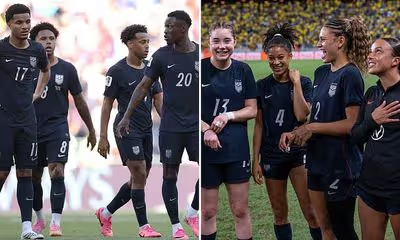
The United States men's national team (USMNT) must divide the $16 million FIFA prize from reaching the World Cup last 16 equally with the United States women's national team (USWNT) under terms of the 2022 collective bargaining agreement (CBA).
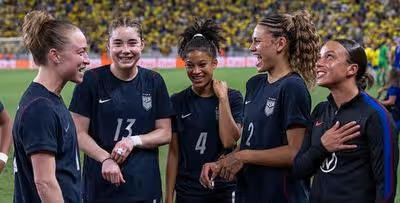
U.S. Soccer will retain 20% of the total payout, with the remaining 80% split between the two squads who make their respective World Cup rosters.
How the numbers break down
Of the $16m, U.S. Soccer's 20% retention equals $3.2m, leaving $12.8m for players.Each national roster — men and women — receives 40% of the original pot, amounting to $6.4m per team.With 26 players per roster, that works out to roughly $246,153.85 per player.
Context: why this matters for equal-pay progress
The split under the CBA is the tangible outcome of years of negotiation and litigation aimed at closing the pay gap between the USMNT and USWNT.The arrangement ensures the men's prize money benefits both teams and guarantees parity in how FIFA payouts are distributed domestically until at least the next bargaining cycle.This mechanism also means any future prize money for the 2027 Women's World Cup will be subject to the same equal-sharing provisions.
Historical contrast
By comparison, when the USWNT exited the 2023 Women's World Cup in the last 16, FIFA awarded the team $1.87m — a figure that highlighted the stark disparity in prize pools between men’s and women’s tournaments and fed the push for parity.Gianni Infantino has publicly stated a desire to equalize men's and women's World Cup prize money by 2027, but structural and political obstacles remain.
Balogun eligibility row exposes FIFA’s political entanglements
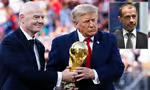
Separately, the decision to allow striker Folarin Balogun to play in the USMNT’s 4-1 defeat to Belgium after a prior red card has sparked controversy because of reported political intervention.Blunt public acknowledgments that the U.S. political sphere influenced FIFA’s disciplinary outcome have raised questions about governance and impartiality at soccer’s global governing body.
IOC complaint and reputational risk for Infantino
London-based NGO FairSquare has signalled it will file a complaint with the International Olympic Committee (IOC) Ethics Commission alleging breaches of political neutrality by FIFA president Gianni Infantino.The IOC’s rules on neutrality apply to members of its exclusive membership, a group Infantino joined in 2020, giving the body jurisdiction to examine whether its standards were violated.If the complaint proceeds, it would force scrutiny of Infantino’s interactions with U.S. political figures and of FIFA’s decision-making processes.
Why the optics—and the politics—matter for U.S. Soccer and FIFA
For U.S. Soccer, the enforced equal split of prize money under the CBA is a win for collective bargaining and for the principle of shared prosperity between its men’s and women’s programs.However, the Balogun episode and the visibility of Infantino’s relationship with prominent political figures risk undermining public trust in FIFA’s independence.That erosion matters because governance credibility affects everything from disciplinary consistency to future negotiations over prize pools and tournament hosting.
What could happen next
If the IOC accepts a formal complaint, FIFA could face reputational sanctions or demands for clearer separation between its leadership and partisan actors.Domestically, the CBA model reinforces parity norms and could influence other federations negotiating player compensation and prize-money distribution.And on the field, both USMNT and USWNT players will continue to feel the effects of these policy decisions in their paychecks and in the broader fight for equality across the sport.
Bottom line
The $16m payout episode is more than a financial footnote: it is a practical demonstration of how collective bargaining can enforce equal treatment, even as FIFA’s governance and external political relationships remain under scrutiny.
Chelsea weigh bid for Bournemouth's Alex Scott as United advance Santos deal
The coming weeks — and any IOC response — will test whether institutional reforms follow the headlines or whether controversy simply becomes another recurring feature of the modern game.
 Mail Online