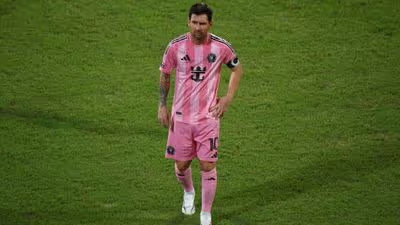
Lionel Messi has purchased Catalonia’s UE Cornellà, a Spanish fifth-division club renowned for its academy, marking his first European club ownership. The move signals a clear focus on youth development and regional talent pathways—linking a global superstar directly to grassroots Catalan football and extending Messi’s growing portfolio of football investments and youth initiatives.
Lionel Messi buys UE Cornellà: what happened
UE Cornellà confirmed Lionel Messi as the club’s new owner in a move that instantly raises the profile of the Catalan fifth-division side. The club framed the acquisition as a long-term, sustainable project built on strengthening institutional foundations and continuing its tradition of developing young talent.
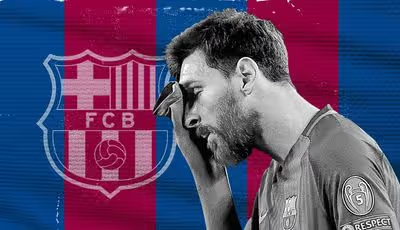
Why Cornellà matters
Cornellà is respected across Spain for producing first-team players and elite prospects—names tied to its academy include Jordi Alba, Gerard Martín, David Raya and Ilie Sánchez. For a club operating outside the professional tiers, its academy reputation has been its main currency, supplying talent domestically and abroad.
Infrastructure, scouting and reputation
Messi’s involvement brings immediate intangible value: global attention, improved recruitment reach and potential commercial uplift. That attention can translate into practical gains—better sponsorships, enhanced training resources and an easier path to retain or attract coaching talent—if the ownership commits resources beyond headline announcements.
How this fits into Messi’s broader football investments
This is Messi’s first club purchase in Europe but not his first ownership role. He is already a partner in Uruguayan side Deportivo LSM and has deep ties to Inter Miami CF as a player. The Cornellà acquisition dovetails with other youth-focused initiatives Messi has championed, including the Messi Cup for under-16 teams, signaling a coherent investment thesis centered on talent development.
Strategic logic
Owning a Catalan academy gives Messi influence over a proven talent pipeline in his home region. For a player whose career was shaped by Barcelona’s academy model, investing in grassroots structures is both symbolic and strategic: it underlines a commitment to developing players while potentially creating a preferred pathway for promising youngsters.
What this means for Cornellà and Catalan football
Short term, Cornellà will enjoy heightened visibility and a likely boost in resources. Mid term, the club faces the operational challenge of converting attention into sustainable sporting gains—upgrading facilities, professionalizing administration, and maintaining community ties without losing its identity.
Risks and practical challenges
High-profile ownership can bring unrealistic expectations. Success will depend on clear governance, sensible investment in coaching and youth infrastructure, and protecting the club’s local fabric. If the project leans too heavily on celebrity without structural reforms, results on the pitch and in development could lag.
What comes next
Expect a phased rollout: announcements on strategic plans, youth-program investments and infrastructure projects are likely first steps. Real sporting return—promotion, player sales or academy outputs—will take seasons, not months. For supporters, the key metric will be sustained commitment rather than short-lived publicity.
Why it matters beyond Cornellà
Messi’s purchase is part of a broader trend of elite players and icons moving into club ownership with an emphasis on development. If executed well, this project could become a model for how global stars can responsibly boost local football ecosystems, balancing ambition with community continuity.
Messi to Newell's? Ronaldo to Sporting? Soccer's potential romantic returns
Barcelona great Lionel Messi has bought Spanish fifth-division team Cornellà, the club announced on Thursday.
 Espn India