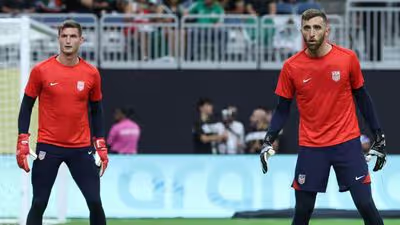
USMNT goalkeeping looks like a genuine concern heading into the World Cup: the likely roster is MLS-heavy and light on European experience, with Matt Freese the expected starter and Matt Turner mounting a late push. Tactical shifts in goalkeeper training and a measurable drop in shot-stopping metrics underscore an urgent development gap the U.S. must address before 2026.
USMNT goalkeeping: a clear weakness as the World Cup approaches
The U.S. men’s national team enters the World Cup with palpable unease about its goalkeeping corps. Matt Freese is the frontrunner, but Matt Turner’s form and the youth of contenders Chris Brady, Roman Celentano and Patrick Schulte mean the position lacks the proven, high-level experience that once defined U.S. keepers.

Who’s in the current goalkeeper pool
Matt Freese (New York City FC) — 27, likely starter after 14 of the last 15 matches under Mauricio Pochettino.
Matt Turner (New England Revolution, on loan from Olympique Lyon) — 31, World Cup veteran pushing late with strong MLS numbers.
Chris Brady (Chicago Fire), Roman Celentano (FC Cincinnati), Patrick Schulte (Columbus Crew) — all 25 or younger, promising but inexperienced at the top level.
Why experience matters — and where it’s missing
The U.S. historically produced goalkeepers with heavy European résumés: Kasey Keller had 281 first-team matches before 1998 (270 in Europe), Brad Friedel had 201 before 2002 (156 in Europe), and Tim Howard had 360 before 2010 (261 in Europe).
By contrast, Freese has about 120 first-team appearances, all in MLS, and Turner has 142 with just 31 European games. That gap in sustained high-intensity, week-in/ week-out European competition helps explain why the position feels less robust now.
Training trends: more feet, fewer saves?
Over the past decade U.S. goalkeeping development emphasized distribution and playing from the back. That tactical evolution produced keepers comfortable with the ball at their feet, but some veterans argue it came at the expense of traditional shot-stopping instincts and bravery.
Coaches acknowledge they now weave passing into training, but critics say core saving techniques and the willingness to throw the body in harm’s way were deprioritized for a period — and the effects are visible at the international level.
Performance data: measurable decline in shot-stopping
Shot-stopping metrics suggest regression. In the 2022 World Cup build-up, the U.S. posted 5.42 goals prevented over 32 competitive games (0.17 goals prevented per game). In the current cycle that figure is 2.25 over 28 games (0.08 per game). Those numbers, limited to post-2018 data, indicate the U.S. keepers have saved fewer goals than expected relative to shot quality compared with the previous cycle.
Form vs. reputation
Numbers show Turner in strong form domestically: high goals-prevented metrics and a superior save percentage to Freese in MLS play. Freese, however, holds the starting nod in most recent U.S. lineups and gained valuable tournament experience in the 2025 Gold Cup, including a penalty shootout win over Costa Rica. Coaches face a straightforward dilemma: back the established camp starter or pivot to the hotter hand.
What this means for the World Cup and beyond
Short-term: The U.S. can reasonably hope a goalkeeper will not be the decisive reason for elimination — tournament play can elevate players — but the position is not a strength and could be exposed by elite opponents. Freese starting would be a vote of confidence in Pochettino’s selection pattern; Turner pushing creates competition, which is healthy.
Long-term: The solution likely lies in a combination of restored goalkeeper fundamentals and more U.S. keepers securing meaningful minutes in Europe. Young prospects such as Brady, Celentano and Schulte have ceilings that remain attractive, but they need the grind of sustained, high-level club minutes to shorten the development curve before 2026.
Coach and development implications
For USMNT staff and U.S. Soccer, the immediate task is mitigating World Cup risk through careful selection and defensive structure. The broader mandate should be recalibrating goalkeeper pathways: prioritize shot-stopping and bravery in youth programs while still teaching distribution, and encourage loan moves or transfers that guarantee playing time in competitive European leagues.
Bottom line
The U.S. is not catastrophically exposed, but the goalkeeping position has slipped from strength to question mark. The current MLS-heavy pool contains capable keepers and high-ceiling youngsters, yet they lack the composite experience — and in some cases the specialized training — that previously separated U.S. goalkeepers on the global stage.
How management balances form, experience and development will shape not only this World Cup campaign but the outlook for 2026.
 Espn
Espn