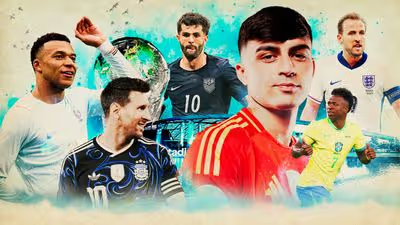
Thirty days from kickoff, Spain are the collective favorites for the 2026 World Cup, but France, Argentina, England and Brazil form a tightly contested top five. Injuries to Lamine Yamal, Kylian Mbappé’s fitness, Lionel Messi’s minutes and managerial questions for Didier Deschamps and Carlo Ancelotti will define the opening narratives as teams head into June.
30 days to kickoff — biggest storylines for the 2026 World Cup
The tournament arrives with familiar favorites and fresh tensions. Spain lead the market of expectation, but France’s depth, Argentina’s reliance on Lionel Messi, England’s tactical reset under Thomas Tuchel and Brazil’s injury cloud create uncertainty among the elite. Group draws and early form will matter: a slow start can end title ambitions in this expanded 48-team format.

Power Rankings: Top 15 explained
1. Spain — FIFA #2 | Group H: vs Cape Verde, vs Saudi Arabia, vs Uruguay
Spain remain the team to beat on paper thanks to elite midfield control and a generational crop of attackers. Lamine Yamal’s hamstring problem is the only true exclamation point — if he’s at full speed, Spain’s creativity becomes almost unguardable. Their group is manageable, offering time to build rhythm ahead of knockout rounds.
2. France — FIFA #1 | Group I: vs Senegal, vs Iraq, vs Norway
France carry intimidating depth but also headline-level complications: Kylian Mbappé’s fitness and club unrest among key players have added noise. Didier Deschamps’ swansong narrative raises the stakes. If Deschamps finds the right attacking balances and avoids locker-room distractions, France have the personnel to win it all.
3. Argentina — FIFA #3 | Group J: vs Algeria, vs Austria, vs Jordan
Defending champions still orbit Lionel Messi, but sustainability is the question. Managed minutes at Inter Miami should help Messi arrive sharp, yet defensive injuries and midfield inconsistency leave Argentina vulnerable. The onus is on supporting figures — Julián Álvarez, Lautaro Martínez and returning defenders — to shoulder moments when Messi is rested.
4. England — FIFA #4 | Group L: vs Croatia, vs Ghana, vs Panama
England’s talent pool is staggering, but pressure and attacking uncertainties persist. Thomas Tuchel’s tactical acumen could be the catalyst to convert potential into trophies, provided he extracts consistency from Jude Bellingham, Phil Foden and Bukayo Saka. Group stage intensity will test whether tactical flexibility trumps raw talent.
5. Brazil — FIFA #6 | Group C: vs Morocco, vs Haiti, vs Scotland
Brazil remain a headline candidate but have underperformed at recent World Cups. Injuries to starters and Alisson’s fitness cloud momentum, while Carlo Ancelotti’s arrival adds intrigue. If Vinícius Jr. and Raphinha hit top form and the defense holds, Brazil can navigate chaos to long tournament life — but details must align.
6. Portugal — FIFA #5 | Group K: vs DR Congo, vs Uzbekistan, vs Colombia
Portugal blend veteran savvy with an in-form club core. Bruno Fernandes’ creative season and Cristiano Ronaldo’s goal threat (even at 41) give Portugal options. Roberto Martínez must manage personalities and fit new-season stars into a coherent system that maximizes both midfield control and counter threat.
7. Germany — FIFA #10 | Group E: vs Curaçao, vs Ivory Coast, vs Ecuador
Germany sit comfortably as the best of the chasing pack. Julian Nagelsmann’s tactical flexibility is a plus, yet questions over finishing and goalkeeping remain. A smooth group stage offers Nagelsmann time to diagnose form problems, but Germany will need clinical edge to progress deep.
8. Netherlands — FIFA #7 | Group F: vs Japan, vs Sweden, vs Tunisia
Not a vintage Oranje crop; fatigue and injuries have sapped momentum. Defensive leadership and set-piece organization are likely the teams’ primary weapons. Without a reliable striker in elite form, the Netherlands may depend on structure more than flair to advance.
9. Morocco — FIFA #8 | Group C: vs Brazil, vs Scotland, vs Haiti
Morocco arrive on the crest of a continental wave — a U20 title and senior momentum behind them. Managerial change to Mohamed Ouahbi signals a shift toward more proactive play. Key will be Achraf Hakimi’s fitness and Ouahbi’s ability to integrate new attackers with the experienced core.
10. Norway — FIFA #31 | Group H: vs Iraq, vs Senegal, vs France
Erling Haaland and Martin Ødegaard provide a world-class spine. When those two click, Norway becomes a realistic dark horse; early group form against Iraq and Senegal will determine whether they can treat the France game as a free swing rather than a must-win.
11. Belgium — FIFA #9 | Group G: vs Egypt, vs Iran, vs New Zealand
Belgium’s golden generation is aging but capable of dangerous spells. Thibaut Courtois’ return stabilizes the back line, and Jérémy Doku’s ascendancy is a genuine asset. Conversion in the final third is the persistent issue; whoever steps up alongside Lukaku will define Belgium’s ceiling.
12. Colombia — FIFA #13 | Group H: vs Uzbekistan, vs DR Congo, vs Portugal
Colombia carry physicality and experienced leadership but lack consistent creative firepower outside James Rodríguez, whose form is uneven. Luis Díaz’s excellent season is a major positive. Expect Colombia to lean on defensive resilience and moments of wing-driven offense.
13. Senegal — FIFA #14 | Group I: vs France, vs Norway, vs Iraq
Senegal combine defensive discipline with elite attacking protagonists like Sadio Mané and Nicolas Jackson. Midfield depth and injuries are the primary concerns. Under Pape Thiaw, the Lions can be compact and explosive — the kind of team that can upend favorites on a given day.
14. Croatia — FIFA #11 | Group H: vs England, vs Panama, vs Ghana
Luka Modrić remains the fulcrum, and Croatia’s continuity is an advantage. Veteran leadership offsets questions about the next generation’s pace. If Josko Gvardiol is fit and the midfield continues to control tempo, Croatia have the knockout-stage temperament to surprise again.
15. Japan — FIFA #18 | Group F: vs Netherlands, vs Tunisia, vs Sweden
Japan’s technical system and collective pressing are reliable, but injuries to Wataru Endō and Takumi Minamino dent experience. Creative wingers like Takefusa Kubo and Kaoru Mitoma can compensate, but defensive fragility must be managed to avoid an early exit.
Injury watch and managerial storylines
Fitness to key players will tilt expectations: Lamine Yamal for Spain, Mbappé for France, Messi’s minutes plan for Argentina, Alisson for Brazil and Hakimi for Morocco are all pivotal. Managerial narratives — Deschamps’ farewell, Tuchel’s tactical baptism with England and Ancelotti’s short-term stewardship of Brazil — add an extra layer where one tactical tweak can change trajectories.
What this means heading into June
Expect volatile group stages where form, not reputation, determines early survival. Teams with manageable groups will use June to iron out cohesion; congested groups will force immediate tactical clarity. Watching how top nations manage minutes, rotations and injuries in the final friendlies will be the best early indicator of tournament readiness.
Key matches and dates to monitor
Mexico vs South Africa on June 11 opens the tournament, but keep an eye on Spain’s June 15 opener, France’s June 16 test against Senegal, and Brazil vs Morocco on June 13 — all early barometers for favorites.
How these high-profile teams perform in their first two games will set the tempo for knockout expectations.
 Espn
Espn