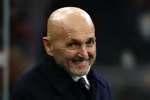
Roberto Mancini has returned as Italy head coach, opening his second spell by promising immediate results and a longer-term rebuild focused on tactical clarity, youth integration and institutional stability. Flanked by FIGC president Giovanni Malagò and technical director Claudio Ranieri, Mancini set a pragmatic agenda to restore Azzurri momentum ahead of the next international cycle.
Roberto Mancini returns as Italy coach — key takeaways from the press conference
Roberto Mancini’s reappointment is presented as both a corrective and an evolution. He laid out a two-part brief: stabilize performances now, and rebuild identity over the coming cycle in the world football.

That message was reinforced by Giovanni Malagò and Claudio Ranieri’s presence, signalling federation backing and a technical structure designed to limit disruption.
Immediate priorities: results, cohesion, and clarity
Mancini emphasised tangible targets: win matches, restore defensive discipline and create clearer tactical roles. That approach speaks to a team still searching for consistency since its highs at Euro 2020. The focus on short-term gains is pragmatic — Italy cannot afford a prolonged transitional slump ahead of European qualifiers and Nations League commitments.
Long-term blueprint: youth integration and a defined playing identity
Beyond immediate fixes, Mancini promised a pathway for younger players and a coherent footballing identity. He wants balance between experienced leaders and emerging talent from Serie A and abroad. This is less about wholesale change and more about structural refresh: developing a midfield engine, sharpening transitional play, and re-establishing the defensive organisation that once defined the Azzurri.
What the technical team means for stability
Claudio Ranieri’s role as technical director signals institutional continuity and day-to-day support for a manager returning to familiar terrain. Giovanni Malagò’s visible endorsement reduces room for mixed messages at federation level. Together, they create a support system intended to buffer Mancini against the political and media pressures that often derail national-team projects.
Squad implications: selection dilemmas and tactical trade-offs
Expect tough choices. Balancing a veteran core with hungry youngsters will test Mancini’s man-management. Tactical flexibility may be prioritised: a stable defensive base, variable midfield shapes and forwards asked to press and exploit transitions. How Mancini handles injuries, club workloads and form across Serie A will determine whether the Azzurri regain momentum or wobble through the next cycle.
Why this appointment matters
Mancini’s return is more than a headline — it’s a bid to recalibrate Italy’s international competitiveness. The federation is signalling urgency without abandoning a measured project. If Mancini delivers clearer tactics and regularly bloods promising talents, Italy could regain its status among European heavyweights; if not, the team risks another period of underachievement.
What to watch next
Key indicators will be the first squad lists, initial tactical setups in friendlies and early competitive fixtures, and how quickly youth prospects are integrated without destabilising results. The pace of change, not just the rhetoric, will reveal whether this second spell can recreate the coherence Mancini achieved earlier in his tenure.
Bottom line
Mancini’s return is a calculated gamble: immediate demands for results wrapped inside a longer-term project to renew Italy’s identity.
Ashley Maynard-Brewer to join Sheffield Wednesday on free transfer, boosting goalkeeping competition
With federation backing and a seasoned technical partner, he has the platform to succeed — but execution across selection, tactics and youth development will determine if the Azzurri move from cautious optimism to genuine resurgence.
 Football Italia