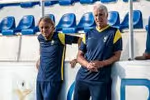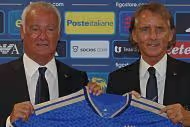
Roberto Mancini returns as Italy head coach on a four-year deal, apologising for his 2023 exit and promising to restore the Nazionale’s EURO 2020 identity. Claudio Ranieri is named technical director after a fractious FITC reshuffle that saw Paolo Maldini and Leonardo step away. Mancini’s immediate task: steady the squad through the Nations League, secure Euro qualification and rebuild Italy’s credibility on the world stage.
Mancini reinstated as Italy coach; Ranieri joins as technical director
Roberto Mancini has been rehired as Italy’s head coach on a four-year contract, presented alongside Claudio Ranieri as technical director. The FIGC reset followed a turbulent recruitment period that ended with senior figures stepping down and the federation opting to start anew under President Giovanni Malagò.
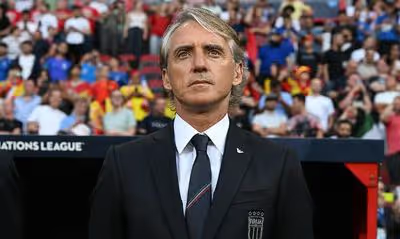
This is a high-stakes recall: Mancini led the Nazionale to EURO 2020 glory and now returns amid public scepticism after leaving for an overseas role in 2023. He publicly apologised for that departure and framed his return as an opportunity to rebuild trust by restoring attractive, effective football.
What Mancini said — ownership and a promise
Mancini admitted the 2023 split was a miscommunication and took responsibility for the fallout. He compared the loss of the role to losing “the love of your life,” signalling genuine contrition and a determination to make amends through performance. He vowed to make Italy play “good and positive football” and believes the current pool of talent — youthful and technically proficient — can deliver that style.
Why the FIGC went back to Mancini
The appointment is pragmatic. Mancini remains the most recent coach to deliver major silverware for Italy and brings instant credibility to a team that failed to qualify for multiple recent World Cups. The federation’s choice reflects a desire for a known quantity who can stabilise the squad quickly ahead of the Nations League and the European Championship qualifying cycle.
That pragmatism carries risk. Reappointing a previously departed coach eases short-term anxieties but raises questions about long-term vision and whether the FIGC will pursue a coherent succession plan beyond this four-year window.
Institutional fallout and context
The process that led to Mancini’s return exposed fractures at the top of Italian football. Paolo Maldini and Leonardo left roles in the recruitment phase, and several high-profile candidates declined approaches, prompting the federation to recalibrate. The end result is a leadership pairing that combines Mancini’s tactical identity with Ranieri’s reputation as a player developer and stabiliser.
Tactical outlook: what might change — and what won’t
Expect Mancini to prioritise possession-based, attacking football with an emphasis on quick transitions and technical cohesion — the hallmarks of his EURO 2020 side. The squad’s younger core offers the athleticism required for high pressing and fluid positional play. Defensively, tightening organisation and restoring collective resilience will be immediate priorities.
This will not be a wholesale reset. Mancini inherits a player pool he knows well, which should speed up tactical implementation. The challenge is converting familiarity into consistent results against top international opposition.
Short-term targets and longer-term implications
Immediate objectives are clear: a strong Nations League showing, secure qualification for the European Championship, then rebuilding momentum toward the World Cup cycle. Mancini’s four-year deal gives him room to implement ideas, but results will define whether goodwill translates into durability.
For the FIGC, the appointment buys time and public reassurance. For Mancini, it is a second chance to prove his earlier success was no fluke and to show that a return from a controversial exit can end in redemption rather than recrimination.
What to watch next
Monitor squad selections for the upcoming Nations League fixtures as an early indicator of Mancini’s tactical priorities and whether he leans on experience or accelerates youth development.
Equally important will be public buy-in: sustained attractive performances will be the quickest route to forgiveness and to re-establishing Italy as a tournament heavyweight.
 Football Italia