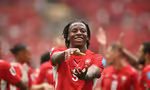
With two weeks until the USMNT open the home World Cup against Paraguay, Mauricio Pochettino’s 26-man squad blends renewed striking promise with uncomfortable defensive and midfield unknowns. Ricardo Pepi and Folarin Balogun arrive in form, but questions over wing dynamism, a thin defensive-midfield profile, and Chris Richards’ fitness leave the hosts leaning on experience rather than clear tactical balance.
Squad verdict: experience chosen over experimentation
Mauricio Pochettino’s roster reads like a cautious, experience-first selection aimed at minimizing shock risks on football’s biggest stage. The manager has leaned on players with European pedigree and prior tournament minutes, even when form-based alternatives existed domestically. That approach gives Pochettino a steady spine but limits tactical flexibility and endangers cohesion if injuries or poor form unsettle his plans.
Striking options: genuine depth at No. 9
Pepi and Balogun provide answers
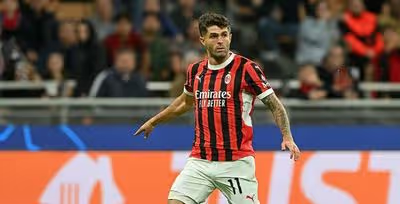
Ricardo Pepi and Folarin Balogun arrive having hit strong patches for PSV and Monaco respectively. Both offer complementary profiles: Pepi’s physicality and directness, Balogun’s movement and link-play. That depth transforms centre-forward from a recurring vulnerability into a potential strength for the USMNT.
Bench options and what they mean
Haji Wright’s inclusion as an emergency option gives Pochettino a different forward profile—retrieval work, aerial threat and energy off the bench. The worry is creativity and goal contribution outside the No. 9 role; if Christian Pulisic’s drought persists, the team will need one of the forwards to carry scoring load plus supply from the wings and midfield.
Wide play and attacking fluidity: worrying signs
Timothy Weah is the only natural winger in the group, despite often lining up at right-back for Marseille. That lack of specialist wide attackers reduces verticality and one-on-one penetration. The omission of Diego Luna — in strong recent form — and the decision not to pick teenage threat Zavier Gozo underline Pochettino’s preference for tested profiles over hot form.
Midfield selection: a conservative gamble
Four central mids against ten defenders
Pochettino took just four central midfielders while stocking ten defenders, signalling a defensive safety net but leaving little cover if injuries hit the engine room. Weston McKennie and Tyler Adams anchor the unit, but the backups—Sebastian Berhalter and Cristian Roldán—offer similar box-to-box traits rather than a distinct defensive-midfield specialist.
What the choices imply
Leaving out players like Tanner Tessmann and Aidan Morris, who impressed with club form, suggests Pochettino prioritises tactical familiarity and experience. That can pay off in knockout football, but it narrows in-tournament tactical tweaks and risks overloading the midfield with like-for-like options.
Defence: fitness and identity before the opener
Chris Richards’ recovery is pivotal. Without a fully fit Richards, the US likely lacks a central defender of his ball-playing and defensive breadth, putting pressure on less assured options such as Miles Robinson and Tim Ream, both of whom have had inconsistent club seasons. The choice between a back four or back five remains open, reflecting uncertainty over personnel and the best way to blend full-back offensives with central solidity.
Cohesion and preparation time: the ticking clock
The squad has had less than two years under Pochettino, and many first-choice starters skipped the 2025 Gold Cup, limiting shared competitive minutes. Tournament success will hinge on rapid tactical assimilation and collective buy-in. This group’s strengths—club-level experience and individual quality—must be welded into a functioning unit quickly if the U.S. are to progress beyond the Round of 16 for the first time.
Immediate outlook and risks ahead of Paraguay opener
Two weeks to kickoff furnishes a narrow window to finalize roles and work on transitions.
Key indicators to watch:
Chris Richards’ fitness timeline, whether Pulisic rediscovers scoring form, and how Pochettino resolves wing responsibility without true wide specialists.
If those issues are addressed, the U.S. can leverage its forward options and tournament maturity; if not, selection conservatism could become a strategic liability.
Bottom line
Pochettino’s squad is defensible and experienced, but not beyond reproach. Striking depth is a real upgrade, yet midfield homogeneity, wing scarcity and defensive fitness concerns create fault lines.
On home soil, the margin for error is slim—how quickly this group turns individual quality into collective coherence will determine whether the hosts meet or fall short of realistic expectations.
 Fourfourtwo