A 30,000-run supercomputer simulation names France marginal favourites for Euro 2028 (14.5%), with Spain (14%) and England (13%) close behind. The projection casts the UK and Ireland home nations as underdogs, flags a worrying dip for Italy, and surprisingly underrates Norway despite Erling Haaland — shaping a tournament where pedigree, momentum and managerial decisions will decide finals day contenders.
France marginal favourites as simulation maps Euro 2028 landscape
A large-scale simulation places France top of the pack for Euro 2028, narrowly ahead of Spain and England. Probabilities show a tight elite group of football teams — France 14.5%, Spain 14%, England 13% — with Germany (11.5%), Portugal (11%) and the Netherlands (8%) close behind.
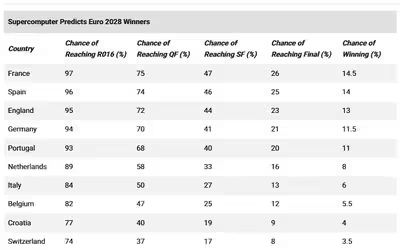
These numbers sketch expectations rather than certainties, but they matter: they set the narrative for national teams, influence preparation priorities, and expose where reputations outpace current trajectories.
Top contenders and what the numbers imply
France’s status reflects squad depth and continuity from recent tournaments. That 14.5% figure rewards balance across attack, midfield and defence and suggests Didier Deschamps' successors (or his continued stewardship) will have a robust platform.
Spain’s 14% underlines their persistent technical quality and youth production. England’s 13% as a home finalist candidate signals respect for squad talent but also hints at pressure: home advantage raises expectations and scrutiny in equal measure.
Germany, Portugal and the Netherlands occupy the chasing pack. Germany’s projection assumes a smooth transition under Jurgen Klopp-era influences; Portugal’s position acknowledges talent even if leadership and aging stars create questions. The Netherlands remain a potent dark horse if injuries and form align.
Home nations and the unfavourable outlook
Scotland, Wales, Northern Ireland and the Republic of Ireland are modelled as underdogs, each with low chances of progressing deep. The simulation gives all the home nations under 20% odds of reaching the Round of 16, a blunt reminder that hosting does not automatically translate to tournament success.
For England, the calculus is different: home support and a strong player pool make them contenders, but the data suggests they're not overwhelming favourites — expectation management and knockout-game temperament will be decisive.
Narrative shocks: Italy’s fall and Norway’s surprising rank
Italy’s projection — markedly lower than historical norms — signals regression since Euro 2020 victory. That sits uncomfortably with a nation used to major-tournament relevance and suggests managerial instability or squad renewal issues.
Norway’s modest placing is the simulation’s headline surprise given Erling Haaland’s stature. The projection implies Norway’s reliance on one transcendent scorer is counterbalanced by shortcomings elsewhere: depth, defensive consistency and the ability to grind results in tournament football.
Mid-table nations and sleepers to watch
Countries like Belgium, Croatia and Switzerland sit not far behind traditional powers, indicating competitive parity across Europe. Austria and Denmark are modelled as capable of upsets and late runs, reflecting improved infrastructures and tactical coherence.
These teams typify the modern Euros: fewer automatic favourites, more narrowly separated contenders, and knockout volatility where momentum and match-ups matter more than history.
Simulation methodology and limits
The projection comes from a simulation that ran 30,000 iterations, factoring team form, player availability trends, rankings and host advantages. Simulations are useful for framing probabilities but are not destiny; injuries, managerial changes, tactical evolution and qualifying performance will alter the landscape long before kick-off.
What this means heading into the qualifying cycle
National teams must treat these projections as a call to action. For favourites, the focus is fine-tuning tournament temperament and depth management. For underdogs, targeted recruitment, youth integration and tactical clarity can close the gap.
Managers will be judged on their capacity to convert probabilistic respect into tangible preparation gains: cohesive systems, reliable rotation and adaptability in tournament settings.
Takeaways and outlook for Euro 2028
The simulation frames Euro 2028 as a tight race among elite nations with room for well-prepared sleepers. France, Spain and England head the list, but margins are thin. Italy’s dip and Norway’s relative under-rating are the biggest stories — both test national programmes more than single tournaments.
How Argentina’s five-year football dynasty closed with the 2026 World Cup defeat
Ultimately, the qualifying campaign, injuries and managerial moves will rewrite these odds. The simulation provides a valuable baseline: it highlights who must improve, who must maintain, and who could surprise when Europe’s best meet in 2028.
 Givemesport