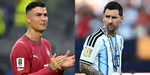
Alexi Lalas’ 2026 World Cup power rankings spark debate: he names France his clear No.1, surprisingly elevates Colombia above Argentina, slots co-host USA at 12th, and pins Haiti at the bottom. The list mixes conservative reads on traditional powers with bold calls for South American and Scandinavian dark horses, setting fresh narratives ahead of a tournament that will test every pre-tournament hierarchy.
Alexi Lalas’ 2026 World Cup power rankings: France top, Colombia over Argentina
Alexi Lalas’ full ranking arrives with a sharpened point of view — France sits at the summit while Colombia earns an eyebrow-raising fourth. The list blends conventional respect for established nations with contrarian placements that will fuel debate through the build-up to the 2026 World Cup. Key takeaways: France favorites, Spain and England close behind, Argentina relegated to fifth, and the United States judged a mid-tier contender at 12th.
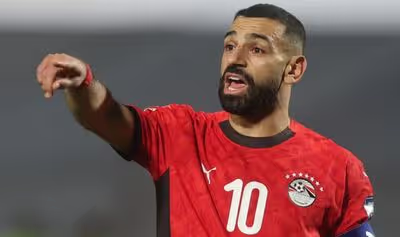
Why France tops the list and what it means
1. France — top billing
France is Lalas’ clear favorite, a verdict grounded in depth, balance and tactical versatility. Didier Deschamps’ squad combines proven winners and elite talent across positions. If form holds, France has the ingredients to repeat — Lalas frames this as a fitting climax for Deschamps if this is indeed his last major tournament in charge.
Contenders and traditional powers (2–7)
2. Spain — continental momentum
Spain’s status as a top pick follows their European Championship success. Their possession base and tactical clarity make them a natural title threat, though knockout football will demand a clinical edge Spain must sustain.
3. England — talent, pressure, expectation
England ranks third: abundant attacking talent and a robust development pipeline give them real hope, but tournament pedigree and knockout ruthlessness remain question marks.
4. Colombia — the most controversial elevation
Colombia at fourth is Lalas’ most provocative call. With Luis Díaz as a central match-winner, Colombia’s blend of physicality and flair can trouble teams — but singling them out above Argentina hinges on peak performances from a compact core rather than broad star power.
5. Argentina — elite, but not top
Argentina lands fifth despite Lionel Messi’s enduring influence. Lalas suggests Argentina remains elite but perhaps lacks the balance or supporting cast depth to rank above Colombia right now — a judgment that will be scrutinized by any Maradona-Messi loyalist.
6. Portugal — youth and structure
Portugal’s young core and midfield control earn them sixth. This is a long-term squad evolving into a tournament-ready unit with both creativity and discipline.
7. Brazil — talent vs. recent volatility
Brazil sits seventh, reflecting extraordinary talent tempered by inconsistent recent form. They remain dangerous at any stage, but cohesion and managerial clarity will determine if they reclaim true favorite status.
Upper outsiders and reliable threats (8–15)
8. Netherlands — experienced spine
The Dutch possess a solid spine (Van Dijk, De Jong) and a tactical identity that keeps them competitive; they’re an outsized threat in a wide-open knockout draw.
9. Germany — always dangerous
Germany’s ninth place downplays star power but underscores identity: even an average German side can progress deep, relying on structure and a ruthless tournament mentality.
10–15. Croatia, Belgium, USA, Morocco, Mexico, Uruguay
Croatia and Belgium offer experience and tactical nuance; both can disrupt bracket projections. The USA at 12th represents Lalas’ measured optimism — home advantage and MLS growth matter, but skepticism about consistency remains. Morocco, rated 13th, is Africa’s highest-ranked side and still a credible dark horse. Mexico and Uruguay round out the pack, each dependent on a handful of world-class individuals like Federico Valverde for Uruguay.
Middle of the pack: dark horses, regional heavyweights (16–31)
16. Norway — sexy dark horse
Norway is a provocative pick at 16 after strong qualifying form and notable results versus top opposition. Lalas warns Norway will need more than Erling Haaland to truly challenge.
17–23. Ecuador, Japan, Switzerland, South Korea, Turkey, Canada, Senegal
Ecuador’s golden generation and Japan’s technical growth make both plausible round-of-16 candidates. Switzerland remains a reliable, structured side; South Korea leans heavily on Son Heung-min’s influence. Turkey’s pragmatic shift could yield tournament resilience. Canada lands in the low 20s despite co-host status, reflecting roster depth questions. Senegal, AFCON winners, are placed as a dangerous but unforgiving pick depending on group draw.
24–31. Austria, Sweden, Paraguay, Scotland, Ghana, Czech Republic, Iran, Saudi Arabia
Austria’s midfield balance is labeled “sneaky good.” Sweden’s attacking duo makes them playable in any match. Paraguay and Scotland are ranked where their pragmatic strengths and fervent support meet tactical limitations. Saudi Arabia’s late managerial change raises uncertainty and influences their slot.
Lower tiers: Africa, Asia, Oceania and emerging sides (32–48)
32–40. Bosnia & Herzegovina up to Uzbekistan
Bosnia’s playoff momentum earns them a mid-30s placement, while African representation populates this band unevenly: Algeria and Egypt show pedigree but face tough groups. Australia is noted for collective solidity rather than standout stars. Uzbekistan arrives as a debutant with limited big-name firepower; one standout defender offers a rare exception.
41–48. Qatar, Iraq, New Zealand, Cape Verde, South Africa, Panama, Curacao, Haiti
The bottom bracket reflects small populations, limited player pools, or debutant status. Haiti anchors the list at 48, facing a steep climb in a group with Brazil and Morocco. New Zealand and other Oceania/CONCACAF qualifiers are honest placements: competitive on their continents but likely to struggle against global heavyweights.
What Lalas’ list reveals about the tournament narrative
This ranking does two things: it cements France as the team to beat while challenging orthodox views on Argentina and Colombia, and it underlines how depth and balance often trump headline names. For co-host USA, a 12th-place ranking is a call for pragmatic progress rather than hyperbolic expectation. Teams ranked in the 10–25 range will be central to knockout surprises; many of them possess the tactical tools to upset traditional favorites.
Implications and what to watch
Managerial stability, group draws and injury luck will validate or contradict these placements. Watch Colombia’s ability to translate individual brilliance into sustained tournament form, Argentina’s supporting cast reliability, and France’s capacity to manage knockout pressures. Home advantage for the USA and Mexico’s passionate support could tilt tight matches. Meanwhile, lower-ranked squads arriving with cohesion and clear tactical plans can still rewrite their positions: World Cups reward peaking at the right moment.
Bottom line
Lalas delivers a ranking that is part conventional power chart, part contrarian forecast.
It sets a debate-ready framework for the months ahead and forces a simple conclusion: talent alone won’t determine the 2026 champion — balance, depth, preparation and tournament management will.
 Givemesport