
England's top referees Michael Oliver and Anthony Taylor face a practical ceiling at the World Cup: FIFA neutrality rules and long-standing political sensitivities mean they cannot officiate matches involving England or Argentina, sharply reducing their chances of refereeing the 2026 final unless unlikely pathways unfold. That constraint reshapes referee selection and highlights how geopolitics still skews football's marquee officiating roles.
Why Michael Oliver and Anthony Taylor are limited at the World Cup
Michael Oliver and Anthony Taylor are among England's elite referees on the World Cup stage, but strict neutrality rules prevent them from taking charge of matches involving their own nation, England. Less obvious to many fans: they are also barred from officiating Argentina games, a constraint rooted in historical and diplomatic sensitivities.
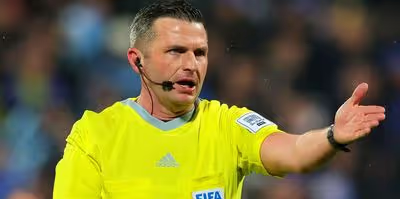
Those two exclusions dramatically narrow their pool of possible assignments and reduce their visibility late in the tournament.
How the rule works in practice
FIFA appoints referees to avoid perceived conflicts of interest. For Oliver and Taylor that means no England games and no matches with Argentina. Beyond single games, they cannot be assigned to matches that lie on the direct elimination path to England — a further limitation when the Three Lions remain capable of reaching the final.
Historic context: why Argentina is off-limits
The prohibition around Argentina stems from enduring political tensions dating back to the Falklands conflict. While football generally aims to rise above geopolitics, that particular episode still shapes official sensitivities and public perceptions in both countries. The result: English referees are kept at arm’s length from Argentina fixtures to avoid diplomatic flashpoints and accusations of bias.
What this means for the 2026 World Cup final
With those restrictions in place, Oliver and Taylor’s odds of refereeing a World Cup final are constrained. They can only be considered for the final if neither England nor Argentina are competing, and also if neither reaches the final via a bracket that would make prior matches problematic for neutrality. Practically, that creates a narrow path — for example, if both England and Argentina are eliminated before the semis or are placed in opposite halves that do not intersect with their appointment history.
Realistic scenarios and limits
The simplest route for either referee to reach the final is for both England and Argentina to be knocked out early. Otherwise, if either team advances deep into the tournament, Oliver and Taylor are likely to be sidelined from semi-finals and the final owing to the need to avoid any appearance of partiality. That’s not a critique of their ability; it’s a structural consequence of how neutrality is enforced.
Broader implications for World Cup officiating
These constraints show how off-field factors shape on-field appointments. Tournament refereeing is not purely meritocratic: geopolitics, national representation and bracket dynamics all influence who gets the high-profile jobs. For fans and teams, that means the list of referees for critical matches is often as much a product of logistics and optics as it is of competence.
Why neutral appointments still matter
Ensuring neutral officials preserves the credibility of outcomes, especially in a tournament where VAR and contentious calls already fuel debate. Keeping English referees away from Argentina or England games reduces potential controversies — but it also removes two respected officials from the pool for the tournament’s biggest fixtures, arguably diluting the merit-based selection.
What to watch next
Follow how tournament brackets unfold: if both England and Argentina are eliminated before the semis, Oliver and Taylor could re-enter contention for the final. Otherwise expect FIFA to lean on other top officials with fewer geopolitical constraints. For analysts, the situation is a reminder to factor appointment rules into any discussion about who will referee the decisive matches.
Final assessment
Oliver and Taylor remain among the world’s top referees, but structural neutrality rules and lingering political sensitivities mean their chances of officiating a World Cup final are limited unless specific, less likely scenarios occur.
That reality underlines a persistent truth in elite football: excellence alone does not always guarantee the spotlight.
 Givemesport