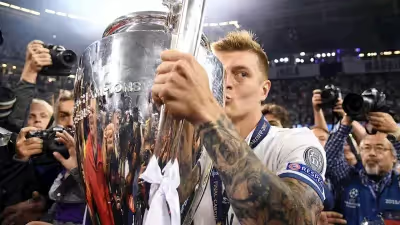
At the Laureus Awards in Madrid, Toni Kroos issued a pointed defense of team-first values, warning that a player's word and collective discipline are fading from modern squads. His remarks landed amid Real Madrid turbulence — an impromptu players' meeting led by Álvaro Arbeloa, a title race slipping away with Barcelona nine points clear, and mounting calls to rebuild the midfield after Kroos and Luka Modrić departed.
Toni Kroos’s message: unity over ego
Toni Kroos used his Laureus Inspiration Award appearance to deliver more than nostalgia. Speaking in Madrid, he stressed that lasting success requires players to subordinate individual ego to the collective. “Within Real Madrid, I tried to be a team player,” he said, adding that winning teams understand “when it was necessary to be a team, to put egos aside, to contribute individual quality so the team could benefit.”
Why his words sting at the Bernabéu
Kroos’s comments resonate because they arrive against a backdrop of visible unrest at Real Madrid. The club is adrift in LaLiga, beaten by inconsistency and, crucially, a perceived erosion of dressing-room cohesion. When a former pillar of the midfield — a player who demanded professionalism by example — publicly laments the decline of “the word” among players, it reads as a thinly veiled critique of the current culture.
Álvaro Arbeloa’s intervention and the dressing-room reality
Álvaro Arbeloa convened an impromptu meeting to press players on commitment and professionalism for the season’s run-in. That gathering underscores the defensive posture at the club: stop the slide, salvage pride, and try to finish on a credible note. With Real Madrid nine points behind Barcelona, the practical chance of catching up is slim; the gathering was as much about standards as about results.
Coaching turnover and the summer question
The season’s likely outcome — a second consecutive campaign without a major trophy — sharpens conversations about change. Coaching staff turnover appears probable, and the Bernabéu hierarchy will be under pressure to reassess recruitment and internal structure. This is not merely about replacing personnel; it’s about restoring an environment where accountability and unity are non-negotiable.
The midfield void: why Kroos and Modrić mattered
Real Madrid have suffered for midfield intelligence and balance since Toni Kroos and Luka Modrić left. Their combination of game management, tempo control and positional discipline papered over tactical weaknesses for years. Current shortcomings have exposed a failure to replace those subtle but decisive qualities, inviting blunt criticism from club elder statesmen and pundits: Madrid need a top-class central midfielder to regain their identity.
Kroos rules out a comeback — and what that implies
Kroos was unequivocal about retirement. “No, honestly, no,” he said when asked about returning. He described his exit as the ideal ending, a choice he does not regret. That seals the book on any romantic solution of bringing the veteran back to plug a gap; Madrid must look forward and invest smartly rather than rely on nostalgia.
What this all means for Real Madrid
Kroos’s remarks function as both a reminder and a rebuke: culture matters as much as tactics. For Madrid to recalibrate, the club must prioritize players who buy into collective standards, recruit midfielders who control matches, and create clear leadership structures on and off the pitch. Short-term band-aids will not suffice; a coherent plan that combines personnel, psychology and structure is required if Los Blancos are to reassert themselves in LaLiga and Europe.
Near-term outlook
Expect a busy summer at the Bernabéu. Coaching changes, significant recruitment and an internal audit of leadership roles are probable.
LEGACY: How David Beckham legitimised MLS and changed U.S. soccer forever
The shape of that response will determine whether Kroos’s words become a catalyst for genuine renewal or a momentarily sharp observation that fades with the transfer window’s noise.
 Headtopics