Manchester City supplied a tournament-sized contingent to the World Cup, producing extremes: Rodri crowned best player as Spain lifted the trophy, Erling Haaland cemented his global status, and a clutch of Blues either underdelivered or left with renewed momentum. Contract moves and mid-tournament transfers added off-field drama, leaving Pep Guardiola with selection and fitness questions ahead of a pivotal season at the Etihad.
Manchester City at the World Cup — the headline verdict
Manchester City sent 19 players to the World Cup and emerged with mixed returns. Rodri’s tournament was exceptional, Erling Haaland reinforced his superstar billing, and newcomers such as Elliot Anderson grabbed headlines.
Equally, several City men failed to hit top form, injuries disrupted plans, and a handful of contract moves created uncertainty going into the club season.
Top performers
Rodri — tournament-defining influence
Rodri finished as the standout player, anchoring Spain’s midfield with composure, positional intelligence and match-winning moments. His World Cup form underlined why City built their midfield around him and makes him impossible to dislodge in Pep Guardiola’s plans. (10/10)
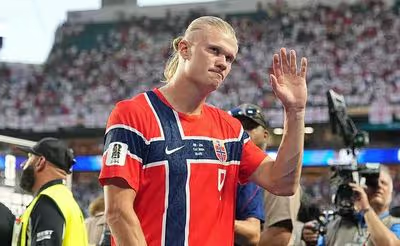
Erling Haaland — relentless and marketable
Haaland again delivered on the biggest stage, scoring regularly and sustaining his reputation as one of world football’s most potent finishers. Beyond goals, his presence altered matches and kept him at the centre of global attention. City return to the season with arguably the tournament’s most complete No.9. (10/10)
Elliot Anderson — instant impact
Anderson adapted smoothly to international pressure after completing a reported club move mid-tournament. He showed creativity and an eye for goal, offering City a genuine attacking option who looks ready to challenge for game time. (8/10)
Solid contributions
Ruben Dias — professional and resilient
Injury disrupted his start, but Dias provided stability for Portugal when fit. He’ll want more tournament success, but his performance suggested he remains a defensive cornerstone. (7/10)
Mateo Kovacic — experienced and composed
Given recent injury history, Kovacic’s minutes for Croatia reminded observers why he remains valuable: quality on the ball and calming presence in midfield. His minutes were limited, but effective. (7/10)
Josko Gvardiol — return from setback
Gvardiol battled back from injury and showed glimpses of the elite defender City signed. A last-gasp disallowed goal was cruel, but the tournament should sharpen his focus ahead of the season. (6/10)
Disappointments and limited minutes
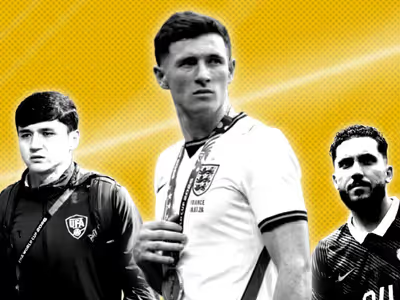
Nico O’Reilly and Marc Guehi — mixed England returns
O’Reilly never made England’s jersey his own and ultimately lost minutes to competition. Guehi, while steadier, indicated he’ll need to sustain club form to become a long-term national starter. (O’Reilly 6/10, Guehi 7/10)
Matheus Nunes and Rayan Cherki — peripheral roles
Nunes made the squad but was rarely called upon to influence Portugal; Cherki found opportunities scarce in a deep France roster and struggled when given minutes. Both must translate City training performances into international impact. (Nunes 5/10, Cherki 5/10)
Other fringe players
Many City players, including Marcello Ait-Nouri, Jeremy Doku, Tijjani Reijnders and others, offered glimpses but not consistent tournament-long influence. Some left with lessons about international intensity and positional discipline. Ratings across the squad reflected sporadic form rather than system-wide dominance.
Transfers, contracts and squad implications
Several off-field developments complicated City’s World Cup narrative. John Stones and Bernardo Silva ran contracts down and became free agents during the tournament, while Nathan Ake completed a move away. The mid-tournament switch involving Elliot Anderson adds both excitement and a selection question for Pep Guardiola: integrate the new signing quickly or manage expectations for a settled playing group.
What this means for Manchester City
City return with clear positives — world-class form from Rodri and Haaland, and a promising arrival in Anderson — but also with selection headaches and fitness questions. Injuries and players returning from long lay-offs will require careful management to avoid early-season fatigue. Guardiola must balance integrating in-form internationals with re-establishing club rhythm and addressing areas of inconsistency exposed at the World Cup.
Short-term outlook
Expect a measured pre-season for those who went deep, targeted recovery for injured players and tactical tweaks to exploit Anderson’s arrival and Rodri’s peak condition. Defensive reinforcements may be eyed if departures are finalized.
Longer-term implications
The tournament clarified City’s core strengths — midfield control and elite finishing — while highlighting depth concerns in certain positions.
Amad and Martinez shine while injuries cloud United's World Cup return ahead of pre-season
How Guardiola navigates contracts, squad rotation and fitness will shape City’s prospects in domestic and European competitions next season.