James Rodríguez has seen almost no playing time at Minnesota United despite the fanfare of his arrival, as coach Cameron Knowles prioritizes a red-hot midfield pairing and the Loons keep winning. Visa delays, fitness setbacks and a brief hospitalization after international duty have compounded the issue, leaving Rodríguez on the bench while Joaquín Pereyra and Tomás Chancalay drive Minnesota’s attack and raise questions about his role ahead of Colombia’s World Cup plans.
James Rodríguez benched as Minnesota United thrive
James Rodríguez’s arrival in MLS has been quieter than expected. The former international superstar has logged only a handful of minutes in recent matches while Minnesota United continue to win without him. That contrast has prompted sharp fan discussion about whether Rodríguez is a genuine tactical asset or primarily a high-profile signing for visibility.
Immediate facts: minutes, lineup, results
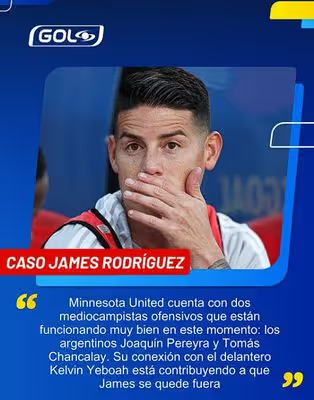
Rodríguez has been restricted to very limited playing time in the last two games, once entering for a single minute. Meanwhile, Minnesota United have assembled a strong run of results, keeping the same attacking structure that has featured Joaquín Pereyra and Tomás Chancalay in advanced midfield roles linking with striker Kelvin Yeboah.
Why Rodríguez isn’t playing: a convergence of factors
Rodríguez’s sparse minutes are not solely a coach’s preference. Administrative delays with his entry to the club slowed his preseason integration, and getting match fit has taken extra time. A post-international-break health setback — a short hospitalization — added another layer of disruption to his availability and conditioning.
Competition for the same role
Tactically, Minnesota United are getting effective performances from their current creative duo. Pereyra and Chancalay have developed chemistry with Yeboah, producing goals and control in the attacking third. When a team is winning and maintaining form, there is little incentive to alter the attacking blueprint for a returning star still regaining sharpness.
Coaching stance and squad dynamics
Cameron Knowles has shown a willingness to keep Rodríguez on the bench despite the player’s profile, signaling a prioritization of form and balance over marquee status. That approach underscores a broader manager-first message: selection is driven by collective performance, not reputation. The squad’s professionalism has also helped avoid public friction around the limited minutes.
Fan reaction and club optics
Fans expected to see Rodríguez regularly after his high-profile arrival, so disappointment is understandable. Some supporters view the signing as more promotional than purely sporting; others temper expectations, noting his need for mileage and fitness. The club’s current results, however, blunt much of the immediate criticism.
Implications for Colombia and the World Cup
Rodríguez reportedly sought game time to push toward World Cup readiness with Colombia. Limited minutes in MLS complicate that objective, but context matters: his fitness and form were disrupted before he could establish rhythm. For national team hopes, sustained minutes — even as a substitute — will be crucial to showcase match sharpness.
What could change—and when
Short-term opportunities for Rodríguez are likely in midweek rotations or matches where circumstances allow for a more attacking substitution pattern. If fitness and training performance improve, he could be integrated gradually without unsettling a winning side. Conversely, prolonged benching would force a reassessment of expectations around his impact in MLS.
Verdict: high-profile signing, real-world limits
James Rodríguez’s situation at Minnesota United is a reminder that pedigree and match readiness are distinct. Administrative hurdles, health concerns and strong incumbents have limited his role; the coach’s calm, form-first stance has kept the team moving.
A calendar flip away from summer could do more harm than good for the NWSL
For Rodríguez, the task is straightforward: regain full fitness, adapt to the team’s rhythm, and earn minutes on merit. For Minnesota, the balance between star power and squad cohesion will define how this chapter unfolds.
 Marca Claro