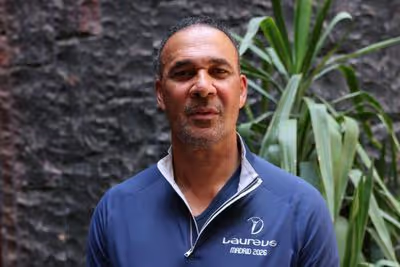
Ruud Gullit names Bayern Munich or Paris Saint-Germain as his Champions League favourites, sees Spain and France leading the World Cup race, and singles out Pedri and Lamine Yamal as standouts — while warning that Italy’s loss of defensive identity and controversial refereeing decisions are reshaping European football’s balance of power.
Gullit tips Bayern and PSG as Champions League favourites
Ruud Gullit believes the trophy will likely come from the Bayern Munich–PSG half of the draw, praising Bayern's cohesion and PSG’s individual star power. His verdict matters because it underlines a wider trend: teams that blend structure with elite talent still have the clearest path in Europe’s elite competition.

Gullit’s view is not about sentiment but balance. Bayern’s tactical discipline and PSG’s attacking firepower create contrasting blueprints for success — and both are built to withstand two-legged knockout dynamics.
World Cup outlook: France and Spain lead, Argentina’s repeat is a long shot
Gullit names Spain and France as favourites for the next World Cup, while acknowledging Argentina’s formidable mentality but noting how rare back-to-back titles are. His assessment places tactical variety and squad depth at the centre of tournament success.
He also voices hope for the Netherlands, underscoring the importance of structure and mental resilience in international tournaments where fine margins decide outcomes.
Players to watch: Yamal, Pedri, Mbappé, Kane
Gullit singles out Lamine Yamal for her exceptional talent and Pedri for his relentless work ethic off the ball — the latter praised for doing the unglamorous work that defines modern midfield influence. He also highlights Mbappé, Harry Kane and the enduring spectacle of Messi and Cristiano Ronaldo at major tournaments.
This mix of youth and established stars illustrates football’s generational handoff: technical brilliance must now sit alongside tactical maturity and physical robustness.
Injury echoes: Bellingham and Gullit’s own experience
Drawing a personal parallel with his own knee problems, Gullit is sympathetic to players like Jude Bellingham working their way back from serious injury. His takeaway is pragmatic: recovery is as much psychological as physical because external expectations rush the process.
That reminder should caution clubs and national teams about the pace of reinstatement and the need to shield returning players from undue pressure.
Serie A’s identity crisis: Italy has lost its defensive edge
Gullit argues Serie A has drifted from the defensive foundation that defined its greatness. He invokes Sacchi-era Milan to stress that defensive work — pressing, structure, ball recovery — was once the daily bread of elite Italian teams.
The implication is stark: without a rebirth of defensive principles, Italy risks being outpaced by leagues that balance pressing intensity with attacking invention. It’s not a call to revive catenaccio, but to rediscover the tactical discipline that underpins sustained success.
Refereeing controversies and VAR’s role
On recent complaints from Barcelona and Real Madrid, Gullit is unsparing: both clubs have benefited from refereeing in the past and now face decisions going against them. He describes Camavinga’s red as harsh but self-inflicted, and Barcelona’s sendings-off as clear under VAR scrutiny.
His analysis is blunt but fair — VAR settles marginal cases, and elite teams must adapt behaviorally and tactically to a system that increasingly leaves little ambiguity.
Politics, racism and the athlete’s voice
Recalling his 1987 Ballon d’Or dedication to Nelson Mandela, Gullit acknowledges the tension athletes face between sporting focus and political expression. He understands why modern players often opt for silence: speaking out can have lasting career consequences.
His stance is nuanced — recognition that sportspeople carry influence, yet live in an environment where activism carries real professional risk.
What this all means — a footballing checklist
Gullit’s commentary stitches together tactical critique, player evaluation and cultural observation into a single thesis: modern success requires balance. Teams that marry defensive organisation with attacking talent, manage recovery prudently, and adapt to stricter officiating will prevail.
Next steps to watch: whether Italy revives defensive coaching at youth level, how Bayern and PSG negotiate the late stages of the Champions League, and which national teams convert squad depth into tournament resilience.
Stats: Haaland's 11 powers City, Salah equals Gerrard's record 9, Bayern win record 34th title
Gullit’s voice is both nostalgic and sharply prescriptive — a reminder that football’s evolution demands both tradition and tactical innovation.
 Marca Claro