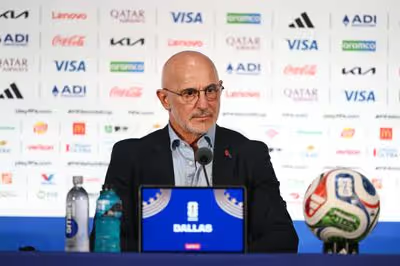
Spain advanced to the World Cup quarter-finals after Mikel Merino’s injury‑time winner against Portugal, but Luis de la Fuente’s postmatch praise stole headlines: he labelled Rodri the team’s “guiding light” and called Arsenal midfielder Martin Zubimendi the world’s second‑best in that role — despite Zubimendi yet to play at the tournament. Spain now face Belgium, with midfield selection the pivotal subplot.
Spain progress but midfield pecking order sparks debate
Spain edged past Portugal 1-0 thanks to Mikel Merino’s dramatic injury‑time strike, booking a quarter‑final with Belgium. The result reinforced Spain’s resilience and squad depth, but Luis de la Fuente’s assessment of his midfield has become the main talking point: Rodri as the linchpin, Martin Zubimendi cast as his immediate understudy — even though Zubimendi has not featured so far in the tournament.
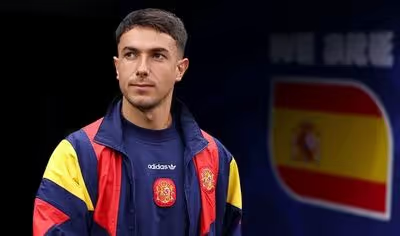
De la Fuente’s praise: signal or selection problem?
The coach’s public ranking does two things at once. It cements Rodri’s centrality — the Manchester City midfielder remains Spain’s chief tempo‑controller and defensive shield — while it highlights the selection dilemma facing a manager with genuine depth. Zubimendi’s rise at club level, capped by a high‑profile transfer to Arsenal last season, explains the plaudits, but his absence from Spain’s starting XI underlines how fiercely contested places are.
Zubimendi’s standing versus minutes on the pitch
Zubimendi arrives at this World Cup with strong credentials: domestic form, technical discipline and tactical intelligence. Yet international tournaments demand immediate chemistry and trust; de la Fuente has preferred continuity with Rodri and other midfield pairings that have been battle‑tested. That leaves Zubimendi as a high‑quality option off the bench — valuable, but underused so far.
What this means for Spain against Belgium
Against Belgium, midfield control will dictate the match. If Spain rely on Rodri to dominate the center, de la Fuente is likely to stick with the structure that reached this stage. Alternatively, Zubimendi’s introduction could be used to alter the dynamic: more pressing, quicker transitions or better cover against Belgium’s counter‑attack threats. Either way, the coach’s deployment decisions will shape Spain’s tactical identity in the knockout phase.
Implications for Arsenal and Zubimendi’s profile
For Arsenal, Zubimendi’s limited minutes are a mixed message. The club invested in a midfielder who has delivered domestically, and his World Cup involvement could further elevate his reputation — but only if he gets action. From an evaluative standpoint, the current situation highlights how top international squads can restrict playing time even for elite club performers.
Beyond midfield: squad depth and individual growth
De la Fuente also highlighted the importance of substitutes and younger contributors. Lamine Yamal earned praise for a defining performance, and the bench produced the decisive moment via Merino. Spain’s rotation options have been decisive in closing tight games, a quality that bodes well in the tournament’s later stages.
Outlook: cautious optimism, tactical clarity needed
Spain enter the Belgium tie with momentum but also a clear tactical question: maintain the Rodri‑led engine or recalibrate with Zubimendi’s specific skill set. De la Fuente has the luxury of choice, which is a strength and a selection headache.
Balogun Saga Overshadows USMNT's 4-1 World Cup Exit — Did Politics Cost Focus?
How he manages those choices will be a major factor in whether Spain can translate squad depth into a deep World Cup run.
 Metro
Metro