
Norway have flown top chefs and a haul of Norwegian ingredients—including hundreds of kilos of fish and 116kg of brown cheese—to the United States as part of an all-in World Cup preparation aimed at giving Erling Haaland, Martin Ødegaard and company every marginal gain. The culinary gamble underscores Norway’s ambition to turn a talented generation into genuine tournament contenders in Group I.
Norway’s culinary strategy lands alongside Haaland and Ødegaard in the US
Norway’s squad has arrived in the United States with more than boots and tactics: two high-profile Norwegian chefs and a large consignment of homegrown ingredients have been shipped over to support the team’s World Cup campaign. The decision to import food highlights how modern international teams use marginal gains—comfort, recovery and nutrition—to try to convert talent into tournament success.
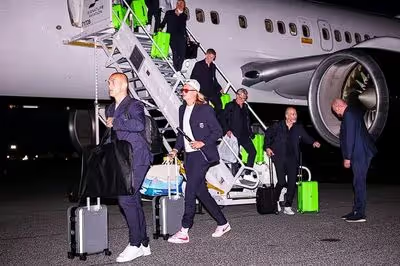
What the team brought and why it matters
The delegation includes Culinary Olympics winner Aron Espeland and Eirik Tufte joining the national team’s long-time chef to prepare meals tailored to elite players. The entourage reportedly flew in hundreds of kilos of red fish and 116kg of traditional brown cheese, underscoring a commitment to familiar, high-quality ingredients.
Supplying bespoke meals is more than cultural comfort. Nutrition calibrated to players’ preferences and physiological needs can aid recovery between training sessions and matches, reduce gastrointestinal disruption from unfamiliar foods, and preserve routines that help mental focus. For a team seeking to punch above its World Cup history, those edges matter.
Sporting context: Norway’s strongest generation
Norway head into Group I with high expectations. Erling Haaland and Martin Ødegaard personify a generation that has raised Norway’s profile: Haaland’s 16 goals in qualification and Ødegaard’s role as midfield conductor frame Norway as a dark horse. Group opponents—France, Senegal and Iraq—offer contrasting challenges, from France’s star-studded firepower to Senegal’s physicality.
Manager Ståle Solbakken has crafted a squad that blends Premier League-proven talent with disciplined structure. The culinary investment is emblematic of a broader push: professionalize every detail around the players to maximize tournament performance.
Logistics and symbolism of flying Norwegian produce
Transporting half a tonne of fish and specialty items across the Atlantic is logistically awkward and costly, but deliberately symbolic. Serving ingredients players recognize—“I know who picked these tomatoes or caught this halibut,” as one chef put it—reinforces national identity and continuity amid the disruption of tournament life.
There’s a psychological component, too. Small comforts can boost morale in tightly scheduled camps, especially for players who spend long seasons abroad. This is a calculated cultural investment that signals Norway does not see itself as a mere participant but as a team committed to preparation.
Immediate schedule and tactical priorities
Norway are based in Greensboro, North Carolina, ahead of a pre-tournament friendly against Morocco in New Jersey on June 7. Their World Cup opens on June 16 at Gillette Stadium in Foxborough against Iraq, with crucial group matches to follow against France and Senegal. With Haaland and Ødegaard leading the charge, early momentum in the group will be decisive.
What this approach reveals about Norway’s ambitions
Bringing chefs and national produce indicates Norway’s broader ambition to grow into a major football nation rather than rely solely on individual stars. It reflects an organizational philosophy: invest across the board—sport science, coaching, logistics and player welfare—to build sustainable success.
If those investments translate into sharper performances and fewer off-field hiccups, Norway’s tactical and technical strengths could combine with enhanced player wellbeing to make them a genuine threat in Group I. If not, the effort will at least show a federation aiming to learn from elite programs and apply those lessons at the World Cup.
Bottom line
Norway’s decision to import chefs and Norwegian ingredients is a concrete signal of intent. It’s a minor logistical extravagance with potentially measurable returns: better recovery, steadier mental states and stronger team cohesion.
The World Cup is packed with superstars
For a nation banking on a golden generation led by Haaland and Ødegaard, attention to detail off the pitch may be the difference between an early exit and a breakthrough run.
 Metro
Metro