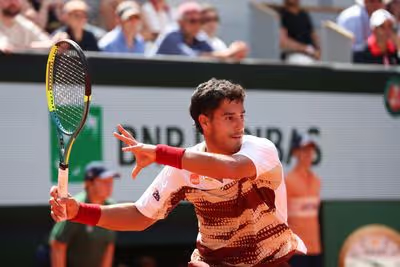
Adolfo Vallejo will face a significant sanction from Roland Garros after publicly saying his five-set second-round loss “should be umpired by a man,” comments denounced by tournament organizers and the French Tennis Federation. The controversy follows a nearly five-hour match on Court Suzanne-Lenglen in which Vallejo fell to French teenager Moise Kouame in a fifth-set tiebreak, and has sparked debate over umpiring, crowd control and gender bias in tennis officiating.
Vallejo to be fined after sexist remarks at Roland Garros
Adolfo Vallejo has been hit with public condemnation and a promised fine from Roland Garros and the French Tennis Federation after saying his second-round match “needs to be umpired by a man.” The comments came after a contentious, nearly five-hour match on Court Suzanne-Lenglen where Vallejo lost to French teenager Moise Kouame 6-3, 7-5, 3-6, 2-6, 7-6 (8). Tournament organizers called the remarks “unacceptable” and reaffirmed that an umpire’s competence is judged by professionalism, not gender.
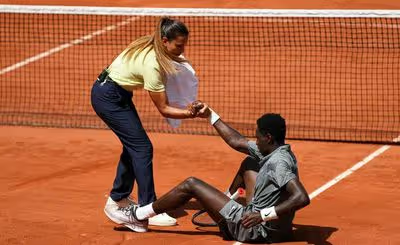
Match context: the facts on court
The meeting between Vallejo and Kouame was a physical, high-drama battle that swung back and forth before a tight fifth-set tiebreak decided it. Kouame recovered from a 5-3 deficit in the fifth and edged the finale 8-7 in the breaker. The match crowd on Suzanne-Lenglen was loud and partisan, at times impacting momentum. Vallejo criticized the umpire, Ana Carvalho, saying she did not control the spectators and that the environment required “a lot of strength” to manage.
Scoreline and key moments
Vallejo took the early initiative, but Kouame rallied mid-match and used the home crowd’s energy to mount a comeback. The decisive tiebreak featured tense points, gamesmanship claims and vocal support for the French player—factors Vallejo cited when defending his comments about the umpire’s capacity to manage the crowd.
Organizers’ response and the sanction
Roland Garros and the French Tennis Federation issued a firm rebuke, stating the outcome of a match “can never justify or excuse” sexist remarks. They announced a “significant sanction” in the form of a fine; the exact amount was not disclosed. For context, players reaching the second round at Roland Garros receive 130,000 euros in prize money, underscoring the financial scale at play.
Why this matters: officiating, crowd control and gender
The incident cuts to two long-standing issues in tennis: how umpires handle intense home crowds and persistent gender biases around authority figures. Umpires at the Grand Slams are selected for experience, not gender, and Carvalho is an established official. Criticizing an umpire’s ability on the basis of sex undermines the professionalism that officiating depends on. At the same time, strong vocal crowds on Suzanne-Lenglen present legitimate operational challenges. The controversy spotlights the need for clearer protocols on crowd management and firmer enforcement to protect officials’ authority.
Impact on the sport and future precedent
This sanction sets a tone: public disparagement of officials that veers into sexism will be penalized. That message matters for player conduct and for protecting the integrity of officiating. Umpires must be supported institutionally so they can maintain control without being subject to gendered attacks. Tournament organizers may be pushed to clarify how crowd interference is assessed and addressed to reduce post-match blame games.
What comes next for Vallejo, Kouame and Roland Garros
Vallejo faces disciplinary measures and reputational fallout; an apology could mitigate consequences but has not been reported. Kouame advances and will deal with the usual next-round tactical questions now amplified by media attention surrounding the match. Roland Garros will likely reinforce support for its umpiring corps and may review crowd-management steps for high-stakes matches on Suzanne-Lenglen.
Takeaway
A gripping match should be remembered for tennis, not sexist rhetoric. Roland Garros’ swift condemnation and a promised fine make clear that comments attacking an official’s competence on the basis of gender are unacceptable.
Biggest Upsets In Early Rounds Of The 2026 French Open
Beyond punishment, the episode is a reminder to the tour and tournament hosts to shore up officiating protections and crowd-control measures so the focus stays on sport, not controversy.
 New York Post