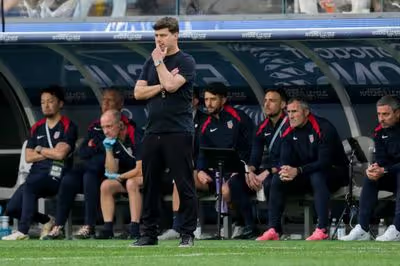
Mauricio Pochettino’s World Cup roster for the USMNT — notably omitting Tanner Tessmann — is the first decisive act of a coach brought in to deliver at a home World Cup. The selection prioritizes tactical balance over individual upside, forcing cascading choices across midfield and attack and setting a referendum-style standard for what success will look like in the next seven weeks.
Pochettino’s roster is a strategic gamble with high stakes
Mauricio Pochettino has presented a roster that reads as a clear statement: structure and balance will trump headline names. Leaving Tanner Tessmann off the trip to final camp and the opening match stands out not simply as a surprise omission but as a signal of a philosophical direction. With this being a home World Cup, expectations are amplified; anything short of progress past the Round of 16 will feel like a missed opportunity.
Why Tessmann matters — and why his absence reverberates
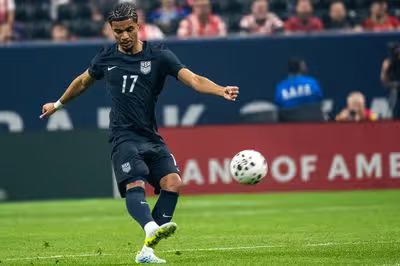
Tessmann was viewed by many as a natural fit alongside Tyler Adams in a holding midfield duo. His exclusion opens immediate tactical questions. Is Pochettino prioritizing midfield industry and tactical discipline over youthful dynamism? Or is he preparing a different midfield profile that emphasizes transitional control and defensive compactness?
This choice forces alternatives into prominence. Weston McKennie becomes the likeliest partner for Adams if Pochettino wants physicality and forward thrust, but McKennie’s best impact often arrives from more advanced roles. Opting for McKennie next to Adams would constrain the team’s attacking variety.
Who benefits from the vacancy? Roldan, Berhalter and the bench calculus
Cristian Roldan and Sebastian Berhalter — neither widely projected as starters before the roster leak era — appear poised for heavy minutes. Their inclusion suggests Pochettino values tactical versatility, work rate and familiarity with USMNT defensive transitions. That approach can create a compact, hard-to-break midfield, but it also narrows creative outlets.
The vacancy also opens the door for an attacker like Malik Tillman to start, but such trade-offs underline a recurring tension: getting the most talented players on the field versus assembling a cohesive unit that executes a system.
Right flank questions: balance or redundancy?
Sergiño Dest, Alex Freeman and Timothy Weah represent three distinct offensive profiles on the right. Individually, each could claim a spot in the strongest XI. Collectively, playing all three simultaneously risks tactical redundancy and defensive exposure.
Pochettino must decide whether to prioritize width and individual dribbling over defensive solidity. A wing-heavy selection could unbalance the backline, particularly if full-back rotations and midfield cover aren’t properly aligned.
Interdependence across positions — decisions cascade
Roster construction is a zero-sum exercise: choices in midfield affect forward selection; right-sided strategies influence left-flank usage and defensive shape. Pochettino’s selections imply a belief that the sum of his chosen pieces will function more coherently than a team built around a few standout individuals.
That’s an analytical, system-first approach. It can yield stronger defensive structure and predictable transitions, but it risks blunting individual creativity when teams need a spark.
How this compares to past U.S. roster controversies
American soccer has long grappled with roster debates — from high-profile omissions to surprise inclusions. Pochettino benefits from a pedigree that tempers the immediate backlash; his European resume grants him a degree of trust not always afforded to previous coaches.
Yet pedigree alone won’t satisfy a home crowd or the federation. The investment in his hiring — a significant financial commitment to bring elite coaching experience stateside — raises expectations that roster decisions will yield measurable tournament progress.
Why Pochettino’s choices will be closely examined
Every omission or inclusion becomes a talking point because the margin for error is thin. The early weeks of preparation and the opening match will be treated as litmus tests. Pochettino will need to clearly articulate the tactical reasons behind contentious calls to maintain credibility and focus within the squad.
His roster already frames the narrative: this is a coach building a team, not merely collecting talent. If the on-field product matches the selection logic, critics will be quieted. If not, his decisions will be viewed as costly.
Outlook: immediate tests and the road ahead
The coming days — final training, the opening match and the inevitable tactical trial by fire — will reveal whether Pochettino’s roster achieves the balance he’s betting on. Expect early lineups to expose his preferred midfield partner for Adams and the degree to which attacking talent will be sacrificed or optimized for team cohesion.
What happens next matters beyond the tournament. A coherent system that advances would validate a process-oriented rebuild. Failure to progress would recalibrate expectations and amplify scrutiny of every selection choice.
Final assessment
Pochettino has taken ownership of a roster that asks more of structure than spectacle. That’s a defensible, professional approach for a coach tasked with delivering results at a home World Cup.
Canadian clubs heading down different paths as MLS enters World Cup break
The roster’s true quality will be judged on whether it translates into a team capable of controlling games, creating chances efficiently and adapting under pressure. The next seven weeks will determine if this strategy was prudent planning or an overcautious misstep.
 New York Post