Aaron Donald has ended his break from the NFL, rejoining the Los Angeles Rams on a reported one-year, $20 million agreement that immediately reframes the offseason narrative around veteran returns. The move, coming after roughly two and a half years away from game-day rosters, reunited one of the sport’s most decorated defenders with the team where he built the bulk of his resume.
A marquee name returns
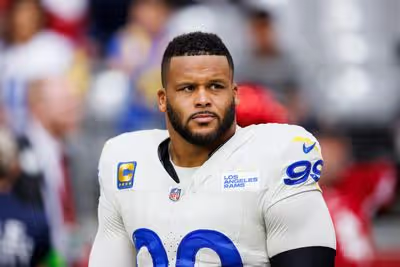
The decision to return places Aaron Donald among a short list of Hall of Fame–caliber athletes who stepped away only to feel the pull back to competition. He came out of retirement after nearly two and a half years and rejoined the Los Angeles Rams on a reported one-year, $20 million deal, moves that underscore why his comeback matters beyond a single contract.
Newsweek reported the terms of the deal as a one‑year, $20 million agreement, marking a clear, high‑profile bet on immediate contribution rather than a long, gradual reintroduction. That framing — a short-term, substantial contract for a veteran great — raises the stakes on how the Rams and the player will manage expectations and workload in the near term.
Preparation, confidence and precedent
Donald has publicly portrayed his return as the product of systematic preparation. “If I didn’t feel like that, I wouldn’t be here,” he said after Sunday's practice, adding that he recorded his training, studied his movements and put emphasis on the football transition and on-field drills, according to Newsweek. Those comments present a picture of an athlete approaching a comeback with the same attention to detail that defined his peak years.
Commentators and writers have framed the move in the context of other elite retirements and returns. Ct Insider noted that Donald’s return is unusual but not unprecedented, joining other Hall of Fame‑caliber players who came back after stepping away. That history gives the Rams’ signing an extra dimension: it is not merely a roster addition but part of a recognizable pattern in professional sports where proven stars opt for another run.
Ct Insider also offered an evaluative point that bears repeating in any discussion of this kind of comeback: few have attempted a return at this stage of a career in the physical shape Donald says he occupies, a factor the outlet suggested provides hope that this one could be successful. That assessment is explicitly an opinion, but it helps explain why this particular comeback commands attention beyond the headlines.
For the Rams, the immediate questions are operational: how to integrate a veteran who claims thorough readiness into practice and game plans, how to protect him from overload after a long absence, and how the roster adapts to an instant‑impact short‑term signing. Those are management and coaching challenges long familiar to organizations that have handled mid‑career returns by star players.
Donald’s own description of his preparation — recording drills, studying every cut and hip movement, and treating the football transition as part of the comeback — frames the player’s return as deliberate rather than impulsive. That narrative reinforces why teams sometimes wager sizable short‑term money on returning legends: the combination of proven accomplishment and demonstrated preparation can justify aggressive roster moves.
Beyond the locker room, the signing will be measured against history and outcomes. Donald’s reunion with the Los Angeles Rams revives conversations about durability, role definition and how much a returning star can alter a team’s prospects in a single season. While no guaranteed blueprint exists for success in these situations, the deal and Donald’s public posture provide a living case study for how an elite athlete attempts to re-enter the highest level of the sport.
What remains clear from the available reporting is straightforward: Aaron Donald has chosen to return, he has done so on significant short‑term financial terms, and he has presented himself as meticulously prepared. Whether that combination yields on-field success will be answered in time, but the move already illustrates the outsized attention and potential impact that high-profile comebacks create in professional sports.