Fines, the Move and When It Happened
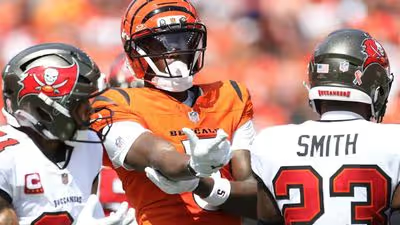
Ja'Marr Chase and Tee Higgins were hit with NFL fines this week for performing a staged "people's elbow" celebration after gaining yardage on the field. Higgins's fines add up to $59,704 while Chase received two penalties totaling $29,852, bringing the pair's total to $89,556.
The celebration involved the players placing their left hand on the right elbow and slowly extending the right arm forward, a choreography the league flagged when it occurred following first downs and, in Chase's case, after a touchdown during Cincinnati's 20-6 win over the Texans.
The financial penalties have effectively ended the routine on game days: what had been a repeated, trademark gesture after first downs and scores will not continue now that the NFL has levied the fines.
Players' Reactions and Immediate Fallout
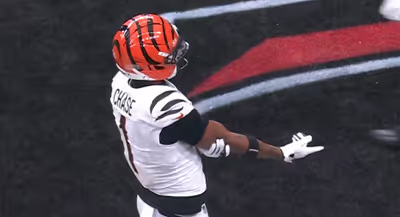
Chase addressed the situation bluntly after the game, saying, "We got fined for the people’s elbow stuff." He also signaled his intent to contest the punishment, telling reporters he "would love to appeal" and describing the celebration as something the group invented as a unique gesture — even framing it as an homage to a wrestling move.
The response from players has been direct and public. Chase's decision to pursue an appeal and his characterization of the act as an invented, team-driven celebration underscores a recurring fault line between the NFL's rule enforcement and player creativity on the field.
The sting of the financial hit is tangible: Higgins's penalties total nearly $60,000, while Chase's two fines approach $30,000. For context, those sums are large enough that the league's enforcement is likely to deter similar coordinated celebrations across rosters leaguewide.
Team Context and Broader Implications
The Bengals' staff and fans watched the fines land amid a performance that has featured stout defensive play while the offense works toward full consistency. Even as the offense searches for rhythm, the receivers' celebrations had become a visible, recurring element in games — one the club will now move away from after the league's action.
Beyond this roster, the episode speaks to an ongoing tension: players use celebrations to build identity and energize crowds, but the league continues to police actions it views as out of bounds. In this instance, the penalties were financial rather than disciplinary suspensions, but they carried a clear message about what the NFL will permit on the field.
For Chase and Higgins, the immediate consequence is the loss of a spontaneous element of game presentation and significant fines. For Chase specifically, an appeal is on the table, and how the league responds to that challenge will determine whether this becomes an isolated enforcement or a precedent that further curtails celebratory choreography.