The Cowboys opened their season with a 28-20 loss to the New York Giants, and the scoreline masked a more alarming development: a defense that looked unsettled and out of sync in the first outing under new coordinator Christian Parker. Dallas fielded eight new starters along the defensive front, and the combination of schematic changes and personnel turnover left the unit exposed throughout the night.
Run fits, coverage and advanced metrics all pointed to a collapse
Dallas’ defensive issues were both evident on tape and stark in the numbers. Advanced metrics showed the Cowboys allowed the worst collective EPA per drive in the league for the week, a marker that captured how often the defense surrendered advantageous situations and failed to close drives. That measure also suggested this outing ranked as one of the worst defensive performances relative to recent history for the franchise.
The problems were multi-dimensional. Run stopping was inconsistent, and pass coverage struggled to generate turnovers or meaningful stops at critical moments. With eight new starters mixing into Christian Parker’s first game calling plays, communication lapses and missed assignments cropped up at inopportune times, allowing sustained drives that set up scoring opportunities for the Giants.
Coaching staff and personnel adjustments will be the immediate focus. A fresh playbook and new responsibilities for many players increase the margin for error early, and the Cowboys’ defense showed how thin that margin can be when those pieces do not align.
Offense produced sparks but couldn’t compensate
The Cowboys received some encouraging individual performances on offense that could temper concern, but they were not enough to overcome defensive shortcomings. Rookie safety Caleb Downs emerged as a bright spot, finishing the game with seven tackles, a sack and a forced fumble. Downs’ activity and playmaking were a clear positive for a defense otherwise searching for answers.
On the ground, Javonte Williams moved the chains at times but could not deliver the consistent chunks the offense needed; he finished with 41 rushing yards on 12 carries. The running game showed flashes but lacked the sustained drives necessary to keep the Cowboys’ defense off the field and the Giants’ momentum in check.
Overall offensive production was uneven. The Cowboys generated moments of efficiency but failed to sustain drives that might have changed the game’s flow and eased pressure on a defense struggling to adapt to new looks and personnel configurations.
Giants’ physical approach amplified Dallas’ issues and lifted New York’s standing
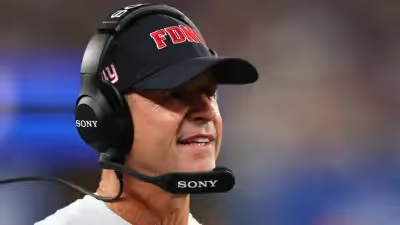
The Giants imposed a physical standard that night, and their performance earned notice across the league. New York’s win propelled the team up 11 spots in the Week 1 power rankings, a jump that signaled growing respect after the victory. Sporting News described the atmosphere around the Giants as energized following the showing, and credited head coach John Harbaugh with setting a tougher tone.
Sporting News quoted NFL writer Nick Shook saying, “It was incredibly refreshing to see the Giants act as the hammer instead of the nail in a prime-time contest,” and added that Harbaugh’s arrival “might not have immediately fixed every issue, but he's clearly set a standard for toughness, and New York dominated in the physical battle against the big, bad Cowboys.” Those observations captured how the Giants’ physicality exacerbated Dallas’ transitional defensive problems and helped swing the game’s momentum.
Sporting News also described a budding quarterback narrative in New York, calling Jaxson Dart a “budding superstar” — a characterization presented as a rumor in coverage of the win. Regardless of how that label ultimately holds up, the Giants left MetLife Stadium with respect and momentum.
What the loss reveals and what to watch next
Sunday’s result made clear that the Cowboys’ immediate priority is stabilization on defense. Personnel turnover and schematic shifts under Christian Parker will require time to settle, but the opening-week film provided a clear list of correctable mistakes: missed tackles, blown assignments in coverage and an inability to close on third downs.
Offensively, the Cowboys have individual pieces to build around. Caleb Downs’ playmaking and Javonte Williams’ ability to pick up positive yards offer a foundation, but the unit’s inability to generate sustained drives amplified defensive exposure and contributed to the loss.
Analysts cautioned that one game should not define a season, and there is precedent for units tightening after early miscues. Still, this opener exposed vulnerabilities that Dallas must address quickly if the team hopes to avoid early setbacks becoming a trend.
For now, the takeaway is plain: the Cowboys’ defense must improve its cohesion and execution, and the offense must convert sporadic success into sustained drives. Until those adjustments happen, the margin for error will remain thin in a league where a single misstep can swing a night — and a season’s tone — in one direction.