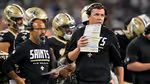
Harbaugh's read on Dart: talent plus patience
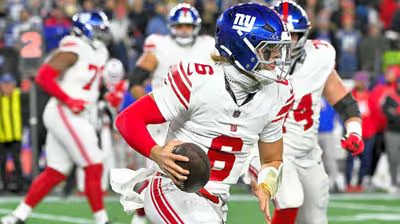
John Harbaugh said in a sitdown with Mike Tomlin that Dart is “even more talented than I thought he was,” adding that “he really has a great pocket presence” and that “he’s learning.”
Harbaugh also tempered praise with a clear view toward development. “He’s learning,” Harbaugh said, and added that the coaches are “doing a great job with him every single day.” Those assessments frame how the organization plans to deploy Dart as the season opens in MetLife Stadium.
A Yahoo! News piece framed broader optimism around the arrival of Harbaugh — calling him the biggest reason for that optimism and crediting him with bringing credibility, culture and leadership — while also arguing that the franchise’s long-term upside “runs through Jaxson Dart.” That report further suggested, as a rumor, that Dart’s potential was one factor in Harbaugh’s decision to take the job.
Rookie production, medical red flags and tactical adjustments
Dart’s rookie numbers make the tension obvious. He rushed for nine touchdowns as a first-year player — the second-most by a rookie in the Super Bowl era behind Cam Newton’s 14 — and carried 86 times for 487 yards, averaging 5.7 yards per attempt. Pro Football Focus graded his rushing at 77.6, ninth among 30 qualified quarterbacks.
At the same time, Dart’s passing profile painted a different picture: a 64.2 PFF passing grade that ranked 34th at the position, a 63.7 percent completion rate, 2,272 passing yards and 15 touchdowns against five interceptions. He also ran for nine touchdowns as a rookie — the second-most by a first-year quarterback in the Super Bowl era behind Cam Newton’s 14 — a split that underscores how much of his scoring came on the ground.
Those rushing plays came with consequences. Dart entered the concussion protocol multiple times, missed two games after a late-season concussion and made several in-game trips to the medical tent. The physical nature of designed keepers and scrambles — plays that invite contact — made injury management an offseason priority.
The Giants addressed that vulnerability in two concrete ways. The front office signed Jameis Winston to a two-year, $13 million extension in part because last winter exposed how thin the drop-off can be when Dart is unavailable. On the coaching side, Harbaugh’s staff spent the offseason working to trim Dart’s exposure without stripping away what makes him effective, folding more of his movement into the passing game rather than relying on pure designed runs.
Momentum from Dallas and the tactical chess match
Confidence arrives with results. In the 2026 regular-season finale against Dallas, Dart completed 22 of 32 attempts for 230 yards, two touchdowns and no interceptions in a 34-17 victory, producing a 110.2 passer rating. That performance is part of why the Giants are comfortable leaning on his dual-threat elements while trying to limit the hits that led to missed time.
The season’s construction reflects that balancing act: New York used a first-round pick on a quarterback who scored nine times on the ground, then organized personnel and red-zone plans around the belief that the trait which makes him electric would not be the one that sidelines him. Defensive fronts without a dominant edge can allow a mobile quarterback to escape pressure — an idea Yardbarker noted when describing how the matchup dynamics and New York’s defensive plan will influence the opener.
As the Giants open the John Harbaugh era against Dallas on NBC at 8:20 p.m., the immediate storyline is straightforward. Harbaugh believes Dart’s ceiling is higher than originally expected and is overseeing an offseason program intended to keep Dart on the field more often while preserving his playmaking. The result on Sunday will be the season’s first test of whether that balance — between maximizing a unique skill set and minimizing contact risk — can hold up under regular-season conditions.