Jacobs’ first rushing touchdown and the celebration explanation
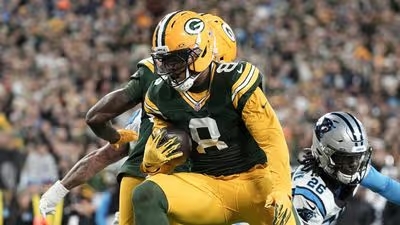
Josh Jacobs broke a personal drought with his first rushing touchdown of the season in Green Bay’s 27-19 Week 8 win at Lambeau Field, and the moment immediately drew attention beyond the scoreboard.
After putting the Packers ahead on a third-and-goal at the 1 with a jump-cut run, Jacobs’ on-field celebration briefly showed him with his hands behind his back — an image that some viewers read as a reference to his May arrest. Yahoo! News noted that the quick clip led fans to assume the gesture was linked to that incident.
Jacobs pushed back on that interpretation after the game. He said the hand-behind-back motion was a fragment of a longer, preplanned routine he and Savion Williams had devised. “Basically, last week, we said the first celebration when I score, I was going to thank God,” Jacobs said. He added the second part of the planned celebration would channel the gospel song “Break Every Chain.”
Jacobs also said the broadcast cameras didn’t capture the full sequence. “They stopped showing the celebration after that,” he said, noting the clip that circulated was only a second long and didn’t reflect the intent behind the routine.
Two touchdowns but limited ground production for Jacobs
Jacobs supplied both a rushing score and a receiving touchdown in the win. He finished with 39 rushing yards on 21 carries and added 13 receiving yards on six catches from six targets, including a touchdown catch from Jordan Love on a third-and-1 at the 4 that helped the Packers convert in the red zone.
Those scoring plays were key: the Packers went a season-best 3-of-3 in the red zone, and Jacobs’ two-touchdown night helped Green Bay secure the victory in his second game back with the team after a six-week absence on the exempt list related to an off-field incident.
Packers’ rushing numbers underscore persistent problems
Despite the scoreboard, Green Bay’s rushing attack offered little comfort. The team compiled only 66 rushing yards on 26 carries for a 2.5-yard average, a figure that highlighted systemic inefficiency even against a Carolina run defense that entered the game near the bottom of the league in rushing yards allowed.
Jacobs’ own running numbers painted a similar picture: Sports Illustrated noted he averaged just 1.9 yards per carry, with a long of 6 yards. That limited efficiency forced the Packers to rely on situational opportunities — short-yardage finishes and red-zone chances — rather than consistent ground movement throughout the game.
Sports Illustrated characterized the broader context bluntly, writing that “Jacobs has not saved the running game” and that Green Bay’s ground attack “was the worst in the league without him and it’s been the worst in the league with him.” Those disputed, sweeping conclusions underline the uncertainty surrounding whether Jacobs’ return will materially change the Packers’ rushing outlook or simply provide short-term scoring help.
What the game revealed about Jacobs and Green Bay
Jacobs’ two touchdowns provided immediate, tangible value — a goal-line run and a touchdown catch that showcased his utility near the goal line and in short-yardage work. But the game also reinforced limits: a 21-carry workload yielded just 39 yards, and the offense produced only 2.5 yards per team carry overall.
Jacobs made clear the celebration was a planned, faith-forward sequence and not a commentary on his past. On the field, though, the larger question remains whether his presence will be enough to rescue a running game that, by the numbers in Week 8, still struggles to generate consistent yardage between the tackles.
After returning, Jacobs scored on the ground and also caught a touchdown, and Green Bay went a season-best 3-of-3 in the red zone. Still, the Packers’ rushing attack managed just 66 yards on 26 carries, and Jacobs gained only 39 yards on 21 carries.