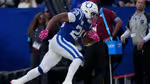
A Louisiana judge has issued an injunction that permits professional players to resume playing college football, a ruling that directly clears Dae'Quan Wright and Zxavian Harris to join LSU’s roster and shields the program from immediate penalties by the NCAA or the SEC while the order remains in effect.
The decision addresses players from the 2022 recruiting class who had believed they exhausted their eligibility but challenged that conclusion after the NCAA adopted a "five-for-five rule." Under the injunction, Wright and Harris are legally eligible to be added to LSU’s team without facing conference or association sanctions tied to roster status for now.
SEC Files Federal Lawsuit; Conference Enforcement at Issue
The temporary court protection has not ended the dispute. The SEC has filed a federal lawsuit against LSU, Lane Kiffin and other university officials, alleging that LSU’s actions violate the conference’s governance rules and undermine the SEC’s ability to enforce conditions for member competition. That litigation elevates the matter from a roster-level legal step to a broader institutional clash over eligibility policies.
Conference officials have tried to maintain a consistent eligibility policy, but recent court rulings have made uniform enforcement more difficult. LSU seized the narrow legal opening created by an earlier temporary restraining order from a Louisiana judge and moved to place the two former pro players on its roster, a step that has intensified the regionwide debate over eligibility standards.
Recruiting, Season Timing and Wider Ramifications
The ruling raises immediate practical and strategic questions for LSU and the sport. One central projection is how long the court’s protection will last and what the SEC will do next; the conference is widely expected to continue its legal challenge. With LSU’s season slated to open against Clemson, the team faces the prospect of integrating roster changes amid an unresolved court fight that could extend beyond Week 1.
Beyond the immediate roster implications, the episode has prompted discussion about whether this legal pathway could alter how college football treats players who previously exhausted their eligibility. Some observers see LSU’s move as leveraging a narrow judicial ruling that could spur additional litigation and policy adjustments around eligibility and the interaction between NCAA rules and federal courts.
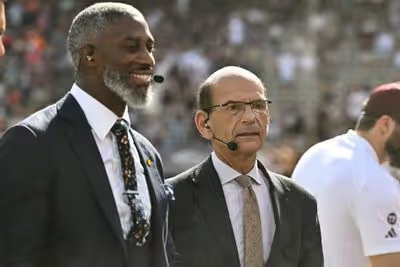
Commentary has been sharp. Paul Finebaum said Kiffin is "just a pawn" in all of this and that LSU’s administration also deserves scrutiny; those remarks reflect opinion and the heightened public scrutiny surrounding the dispute.
The situation remains fluid: the injunction has cleared the way for Wright and Harris to play, but the SEC’s federal suit and the uncertain duration of judicial protection ensure the matter will be decided in courtrooms and boardrooms as much as on the practice field.