League conceded the flag shouldn't have stood
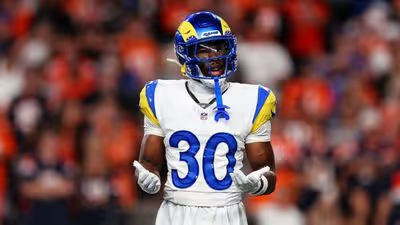
The most consequential development from the Los Angeles Rams’ loss to Denver came after the final whistle: the NFL told the Rams that the defensive pass interference flag on Josh Wallace should not have been called.
Rams head coach Sean McVay confirmed the league's acknowledgment this week and said the club had formally submitted the play for review to get clarity on the ruling. McVay stressed that the move was rooted in teaching and prevention — not an attempt to alter the scoreboard after the fact. “The most important intent is making sure we educate our players on how it's being officiated so there's clarity of how we can coach them to play technique and fundamentally through the cycle of the snap,” McVay said.
McVay added that the league “agreed” with his assessment that the penalty was incorrect, an admission that underlines the gravity of the moment: the flag erased what would have been a game-sealing takeaway and extended Denver’s final drive.
How the call changed the finish and what it means for the Rams
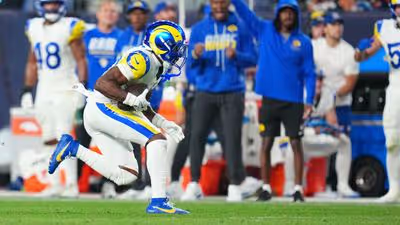
The on-field consequence was immediate. A few plays after the penalty, Denver’s Nix punched it in from the 1-yard line and the Broncos took a 30-26 lead, leaving Los Angeles 47 seconds to respond. The sequence shifted win probability at the game’s most critical stretch, turning a likely Rams victory into a defeat.
Some coverage of the play characterized the situation differently. Yahoo! News described the sequence as the Rams player landing on the “wrong side” of the call, keeping Denver’s drive alive and leading to the touchdown; that characterization remains disputed. Separately, analysis published by Bleacherreport projected that the penalty likely prevented the Rams from winning the game, a judgment framed explicitly as a projection rather than definitive proof.
McVay’s decision to take the play to the league speaks to a broader emphasis inside the Rams organization: convert contentious moments into teachable ones. Rather than seek retroactive remedies — something the NFL’s postgame acknowledgments don’t change on the scoreboard — McVay framed the outcome as information the coaching staff can use to refine technique and instruct players on how similar situations are being interpreted by officials.
Immediate and longer-term implications
For the Rams, the immediate impact is the loss itself and the questions it raises about late-game officiating consistency. The NFL’s admission that the call was incorrect provides vindication for the team’s protest, but procedural realities mean the result remains unchanged.
On the practical side, McVay emphasized using the league’s feedback to adjust coaching points. That approach keeps responsibility internal: rather than litigating outcomes in public, Los Angeles intends to translate the league’s guidance into on-field corrections and clearer expectations for players when contested plays arise.
There are limits, however, to what such acknowledgments accomplish. League confirmations of missed calls rarely reverse results, and the Rams must now absorb the loss and its effect on their season trajectory on the field. Still, an official admission can sharpen teaching moments and may influence how referees are briefed or how similar situations are handled going forward.
Ultimately, McVay’s message to his team was procedural: get clarity, coach the correct technique and reduce the chances of being on the receiving end of a crucial call in a key moment. The league’s agreement that the flag should not have been called gives that effort a concrete example to build around — but it won’t, by itself, change the scoreboard from Sunday night.