Medical timeline and on-field signs of progress
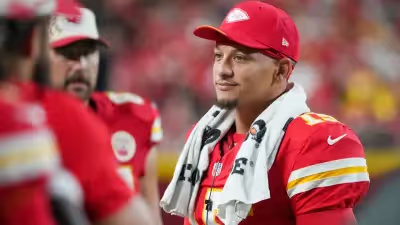
Patrick Mahomes underwent surgery on December 15 to repair torn ACL and LCL ligaments in his left knee. Since then, he was cleared for full training-camp participation in July and spent camp working with the first-team offense. He was kept out of preseason action as a precaution and is currently on course to start on September 14 against the Denver Broncos.
Coaches and staff have pointed to specific practice moments as evidence his mobility is returning. During an August 18 practice, Mahomes rolled right, stopped abruptly to evade a defender and completed a touchdown throw to Rashee Rice — a sequence the team highlighted in its practice report as an example of his progress. Team officials describe that sequence as a positive sign over his mobility, and it has been used internally to mark where his recovery stands.
Questions at the margins: lingering doubts and outside skepticism
Despite the cleared participation and practice reps, some outside evaluators remain cautious. The Sun reported that Mahomes has "sparked fresh injury fears" and that one NFL executive questioned whether he would be able to move properly after the major knee surgery. That concern, as relayed by The Sun, reflects unease among some league evaluators rather than an official medical finding.
The cautious approach during the preseason — keeping him out of games despite full participation in camp — appears to reflect the club’s desire to manage risk while reintroducing game-speed variables gradually. The public practice highlights and the timeline toward a September start underscore why internal voices are optimistic, but the externally voiced doubts explain why some evaluators graded the situation conservatively.
Roster shifts in the secondary and what they mean for Kansas City’s path
Compounding the debate over Mahomes’ readiness is roster turnover in the secondary. Kansas City has lost several key players: Two-time All-Pro Trent McDuffie and Jaylen Watson were traded to the Los Angeles Rams, and safety Bryan Cook signed with Cincinnati. Those departures are confirmed changes that alter the team’s defensive blueprint and depth, especially against top passing offenses.
From a personnel standpoint, the losses in the secondary shift the balance of how the defense will be constructed and how much pressure the offense may need to shoulder. The confirmed departures are separate from the medical narrative around Mahomes, but together they form the factual backdrop for any realistic evaluation of Kansas City’s Super Bowl chances this season.
Travis Kelce has been one of the most visible voices on the team’s internal response to the situation. Sporting News relayed Kelce’s perspective on what he has seen in Mahomes’ mindset and preparation — remarks Kelce said played a factor in his decision to remain with the franchise. Kelce added, “I could see the frustration in his mind that it got to this point this year… Like, I want to be there for that guy, you know, in every aspect of the game,” comments that convey confidence in Mahomes’ commitment and recovery.
That endorsement from a longtime teammate is meaningful inside the locker room, but it does not eliminate the outside questions. Sporting News framed Kelce’s remarks as an expression of belief in Mahomes’ ability to contribute; that remains an opinion rather than an independent medical or performance verdict.
Balancing progress with prudence
Factually, Mahomes’ surgical date, clearance for full participation in July, practice reps with the first-team offense, and the team’s decision to withhold him from preseason games are established elements of his recovery timeline. The practice touchdown the team promoted is a concrete example of regained mobility. Still, a portion of league evaluators — as reported by The Sun — voice uncertainty about his ability to move at peak levels after a significant knee reconstruction; that viewpoint remains unconfirmed beyond the quoted skepticism.
At the same time, confirmed roster moves in the secondary have changed Kansas City’s defensive profile heading into the season. Those departures are independent, verifiable shifts that interact with the team’s Super Bowl calculus: returning on-field production from key offensive contributors and the ability of a reworked defense to contain elite passing attacks.
The clear reporting points are straightforward: Mahomes has completed surgery and a documented rehabilitation timeline that has led to full participation in camp and a plan for an early-September start, and the Chiefs’ secondary has lost established starters. Where opinions diverge — among teammates, team communicators and outside executives — is how those two threads combine to affect the franchise’s championship window. For now, progress on the field and confirmed roster losses set the parameters for both optimism and caution as the season opens.