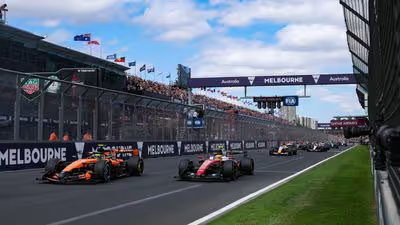
Bahrain appears set to reclaim the role of F1 season-opener in 2027, with a March 14 start likely after Ramadan concludes. That shift would move the Australian Grand Prix out of Round 1 despite Melbourne’s recent openings, driven by contractual clauses, Gulf pre‑season testing and logistics. Turkey’s confirmed return further tightens a near‑final 24‑race calendar, reshaping the early-season rhythm.
Why Bahrain is poised to open the F1 2027 season
Bahrain’s likely March 14 slot is a straightforward outcome of timing and logistics. Ramadan is expected to finish on March 7, clearing the way for Gulf venues to host the opening race without the constraints of the holy month. Bahrain also hosts pre‑season running in the region, making it the logical operational choice for F1 teams and organisers.

Operational advantages and precedent
Starting the year in the Gulf reduces long-haul travel immediately after testing and helps circuits that already host winter work. Bahrain has historically been a season-opener multiple times, most recently in 2024, and the infrastructure and paddock arrangements suit a March start better than an antipodean jump to Melbourne.
What this means for the Australian Grand Prix
Under its current hosting deal, the Australian Grand Prix must appear among the first three events of the season. With two guaranteed opening slots already used, Melbourne still retains those contractual protections — but not necessarily the top billing. Expect Albert Park to feature in early April, likely as the third event, kicking off an Asian swing rather than opening the entire championship.
Melbourne’s changing status
From 1995 to 2019, Albert Park was routinely Round 1; that pattern broke after the 2020 cancellation. The last two seasons have been exceptions rather than the norm, and losing the opener title again reduces the domestic promotional advantage that a standalone season-beginning race brings. Still, an early-April spot keeps Australia influential in the opening narrative, just not the very first headline.
How Turkey and Portugal reshape the mid-season map
Turkey’s confirmed five‑year return locks in one of the 24 calendar slots and narrows the remaining placement choices. Portugal (Portimão) is a natural replacement for Barcelona next year and fits in early‑European dates, but it can also be slotted later if organisers prioritise geographic sequencing and weather windows.
Logistics and calendar flow
Placing Turkey later in the summer serves as an efficient stepping stone out of Europe en route to Azerbaijan and Singapore, smoothing freight movements and reducing costly backhauls. These mercantile considerations increasingly dictate the order of races as F1’s global footprint grows.
Projected F1 2027 calendar (possible ordering)
Round 1 — Bahrain | March 14
Round 2 — Saudi Arabia | March 21
Round 3 — Australia (Albert Park) | April 4
Round 4 — China | April 11
Round 5 — Japan | April 25
Round 6 — Miami | May 9
Round 7 — Canada | May 23
Round 8 — Monaco | June 6
Round 9 — Portugal | June 13
Round 10 — Austria | June 27
Round 11 — Great Britain | July 4
Round 12 — Belgium | July 18
Round 13 — Hungary | July 25
Round 14 — Spain | August 29
Round 15 — Italy | September 5
Round 16 — Turkey | September 19
Round 17 — Azerbaijan | September 26
Round 18 — Singapore | October 10
Round 19 — United States | October 24
Round 20 — Mexico City | October 31
Round 21 — Sao Paulo | November 7
Round 22 — Las Vegas | November 20
Round 23 — Qatar | November 28
Round 24 — Abu Dhabi | December 5
Key takeaways and what to watch next
The calendar is taking shape, but confirmation may not be immediate — the 2026 schedule was announced as late as June. Teams should prepare for a Gulf‑led opening that favours Bahrain’s testing familiarity, while Melbourne will pivot to an early‑season role that still carries weight for fan engagement and commercial revenues. Expect final slotting for Portugal and Turkey to be the last pieces organisers resolve.
Why this matters for teams, broadcasters and fans
A Gulf opener simplifies early logistics and aligns broadcast windows with traditional European primetime as the season immediately moves back across continents. For teams, shorter early travel legs reduce strain and cost; for broadcasters and markets, the opening narrative shifts from an antipodean spectacle to a Gulf showcase. Fans in Australia lose the prestige of a season curtain‑raiser but retain an important early slot that anchors the Pacific leg.
Looking ahead
With all 24 slots effectively allocated by return deals and contractual clauses, the 2027 calendar is more predictable than in years past. Still, organisers will fine‑tune dates around commercial deals, local events and operational constraints.
The emerging pattern underlines a broader reality: F1’s calendar is now as much about efficient global logistics and commercial alignment as it is about sporting tradition.
 Planet F1