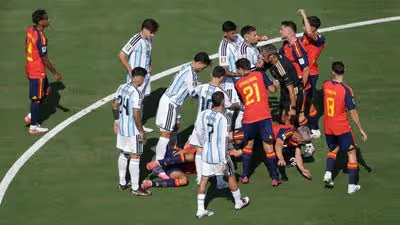
Breaking: FIFA has opened a formal disciplinary investigation into Argentina after political banners and a violent on-field brawl marred their 2026 World Cup run. Several players and staff face assault and misconduct charges, while the AFA is accused of multiple regulatory breaches — fines, match bans or stadium sanctions could arrive before the September international window as FIFA proceeds toward hearings and potential punishments.
FIFA opens disciplinary case against Argentina after World Cup incidents
FIFA has confirmed a formal investigation into Argentina following multiple incidents during the 2026 World Cup that breached competition rules.
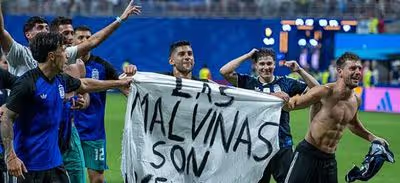
The inquiry focuses on a political banner displayed by players, a post-final on-field brawl involving Argentina personnel, and additional organizational breaches attributed to the Argentine Football Association (AFA). Those implicated will be invited to respond before any sanctions are imposed.
Banner controversy: "Las Malvinas son Argentinas"
During celebrations after the semifinal, several Argentina players displayed a banner reading "Las Malvinas son Argentinas" — a political statement concerning the Falkland Islands. FIFA regulations bar demonstrations of a non-sporting nature at events, and the AFA has prior history with similar incidents and fines.
The players primarily identified with the banner include Cristian Romero, Lisandro Martínez and Giovani Lo Celso. FIFA can prosecute individual misconduct as well as association responsibility; precedents exist where players received match bans and federations were fined.
Why the banner matters
A political message on football's biggest stage shifts a sporting moment into a diplomatic flashpoint. Beyond the immediate regulatory breach, such actions risk inflaming international sensitivities and invite stricter punishment given the World Cup's global profile.For Argentina, a nation that prizes football as soft power, this is an avoidable reputational cost that could have been mitigated by clearer team protocols.
World Cup final brawl: charges against players and staff
The World Cup final deteriorated into a physical altercation that has produced specific FIFA charges against Argentina individuals:
- Leandro Paredes: three counts of assault
- Nahuel Molina: two counts of assault (one completed, one attempted) and one count of unsporting behavior
- Roberto Ayala (assistant coach): one count of assault
- Thiago Almada: one count of unsporting behavior
Those found guilty of violent conduct face suspensions under the FIFA Disciplinary Code; violent conduct typically attracts multi-match bans, and the code allows for extended or global bans depending on severity.
Immediate sporting impact
Any suspensions could bite in the next international window starting Sept. 21, which includes four fixtures before Oct. 6. FIFA can apply sanctions immediately and enforce them across all competitions, meaning bans would count even if affected players are not selected at the moment. For Argentina, losing players like Paredes or Molina for multiple matches would complicate midfield and right-back options and alter tactical planning for upcoming qualifiers and friendlies.
Other charges: institutional and supporter-related breaches
The AFA faces additional counts linked to supporter conduct, late kickoffs and alleged failures to comply with match and security protocols.Those types of breaches usually result in fines or conditional stadium restrictions, but repeated or severe failures can lead to partial or total stadium bans or suspended sanctions intended as deterrents.
How federations are typically punished
FIFA disciplinary outcomes vary: fines and warnings are common for administrative failures; stadium bans or reduced-capacity orders are used for persistent or serious crowd misconduct; individual players or officials face match suspensions for violent conduct or unsporting behavior. The specific penalties will hinge on incident severity, prior history and whether the AFA can demonstrate corrective measures.
What happens next — timeline and probable outcomes
FIFA will allow the AFA and individuals to submit responses before holding hearings. Decisions can range from fines and short suspensions to longer bans for violent conduct; global suspensions remain possible but are reserved for the most egregious cases.Punishments could be announced before the September international window, but timelines are case-dependent.
Why this matters for Argentina’s 2026 outlook
Beyond immediate match availability, the investigation threatens to prolong a distraction at a crucial transitional moment for Argentina’s squad. Sanctions would not only affect selection but also the team's public standing and relations with fans and international bodies. For coaching staff and federation officials, how they manage discipline and messaging now will determine whether this becomes a short-term headache or a longer reputational wound.
Analyst verdict: avoidable, manageable — but instructive
This is largely a self-inflicted complication. Celebratory heat and weak institutional controls created a situation that FIFA was always likely to penalize. The penalties available are significant but, in most scenarios, manageable for a talent-rich Argentina team if handled swiftly and pragmatically.The crucial variable is governance: swift internal discipline, transparent cooperation with FIFA and preventive measures for future matches will limit sporting damage and repair public trust.
Key next steps to watch
- AFA and the named individuals’ formal responses to FIFA.
- Timetable for hearings and any provisional measures.
- Specific sanctions: fines, match suspensions or stadium restrictions.
- Impact on Argentina squad selection for the Sept. 21 international window.
FIFA’s disciplinary process is now the dominant off-field story for Argentina.
Vieri says Hong Kong City vs Inter friendly is a vital pre-season tune-up
The coming weeks will reveal whether this episode becomes a momentary blemish or a more consequential fracture ahead of the next competitive cycle.
 Si
Si