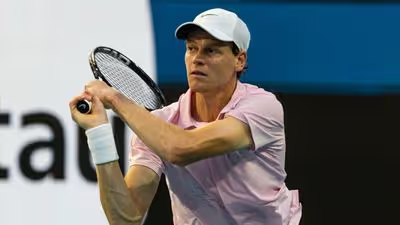
Jannik Sinner arrives at Roland Garros as the unmistakable favorite after Carlos Alcaraz’s wrist injury removed the chief obstacle to a 2026 French Open title; Sinner is now in position to complete a career Grand Slam of tennis amid a men’s draw that feels more like a coronation than an open race, with a mix of veteran threats and dangerous dark horses lurking below him.
Tournament outlook: Sinner vs. the field at Roland Garros 2026
Jannik Sinner is the clear headline — dominant this season, peaking on clay and carrying the weight of favorite status into Paris. Carlos Alcaraz’s withdrawal with a wrist issue dramatically reshapes the draw, elevating Sinner from top contender to the man everyone must beat. That shift matters: Sinner can complete a career Grand Slam here, and the path is unusually clean for one player to impose his game on the rest of the field.
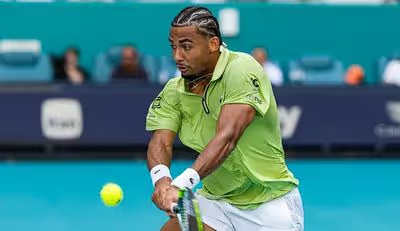
Why this draw is lopsided
The absence of the two-time defending champion removes the tournament’s hottest counterbalance. Novak Djokovic remains a perennial threat but is advancing toward 39 and managing a reduced schedule. Alexander Zverev, Félix Auger-Aliassime and a handful of veterans and rising figures create texture, but none match Sinner’s recent form. On clay, consistency and momentum matter more than star power alone — and Sinner has both.
Immediate implications for key contenders
Novak Djokovic: Age is a storyline, not a verdict. Djokovic still has Grand Slam instincts in five-set battles and will be dangerous if he finds rhythm, though a brutal draw and limited match play are complicating factors.
Alexander Zverev: Reliable at the top level, Zverev lacks a major title but does possess clay experience and the firepower to upset in the later rounds. He’s more a spoiler than the favorite.
Félix Auger-Aliassime and Daniil Medvedev: Both can produce high peaks and remains unpredictable. Auger-Aliassime’s clay form is mixed; Medvedev oscillates between brilliant and erratic. Neither inspires the same confidence as Sinner but both can derail runs.
Top 16 seeds to watch
1. Jannik Sinner
Sinner’s recent results and court management make him the tournament’s engine. If he avoids extreme heat and an early blip, he should be the last man standing.
2. Alexander Zverev
A perennial top-five performer whose ceiling is high but whose clay CV lacks a Grand Slam breakthrough.
3. Novak Djokovic
Experience and unflappable big-match DNA keep him dangerous; the question is durability deep into best-of-five clay battles.
4. Félix Auger-Aliassime
Resurgent at times but uneven on clay; a tough first-round test complicates his window.
5. Ben Shelton
A physical, aggressive player who has shown clay adaptability — still searching for a major statement.
6. Daniil Medvedev
Capable of brilliance; clay remains his variable. When locked in, he can trouble anyone.
7. Taylor Fritz
Competitor who grinds hard; clay is a question mark but he won’t be an easy out.
8. Alex de Minaur
Relentless defender whose fight keeps him afloat, likely to push matches into tight margins.
9. Alexander Bublik
High-ceiling, streaky; when Bublik finds rhythm, he’s dangerous on any surface.
10. Flavio Cobolli
Entertaining and erratic; a potential upset artist on good days.
11. Andrey Rublev
Talent-plus-inconsistency defines him — a threat if the fire is lit.
12. Jiří Lehečka
Streaky but increasingly comfortable on clay; a dark-horse profile.
13. Karen Khachanov
Professional and strong in bursts, tends to fade against higher-octane opponents.
14. Luciano Darderi
Clay specialist with a recent run that suggests he can punch above his seeding.
15. Casper Ruud
Twice a Roland Garros finalist; on his best day he’s among the handful who can challenge for the title.
16. Valentin Vacherot
A feel-good story and top-16 presence; heart and momentum could carry him further than expectation.
Seeds 17–32 and the dark-horse corridor
This band supplies the tournament’s unpredictability: Arthur Fils, Alejandro Davidovich Fokina, the Argentine contingent (Francisco Cerúndolo, Tomás Martín Etcheverry, Sebastián Báez, Mariano Navone), Tommy Paul and rising Spaniards like Rafael Jódar. Young prospects João Fonseca, Alexander Blockx and Dino Prizmić can upset rhythms, while veterans such as Stan Wawrinka and Matteo Berrettini remain dangerous on a given day.
First-round matches to watch
Fils vs. Wawrinka — the young pretender versus a former champion; ideal narrative clash.
Etcheverry vs. Nuno Borges — clay grinder versus steady mover.
Rublev vs. Ignacio Buse — flair against rising form.
Djokovic vs. Giovanni Mpetshi Perricard — serve vs. return in an intriguing stylistic test.
Frances Tiafoe vs. Eliot Spizzirri and Marin Čilić vs. Moïse Kouame also offer early drama.
What the draw suggests about the tournament arc
This is shaping as a Sinner-centric event: if he plays to his level, the Paris fortnight becomes an exercise in control and margin management. The tournament’s main narratives now revolve around whether veterans can summon late-career runs and which young players can seize a breakthrough window.
Clay’s peculiarities — long points, tactical patience, weather influence — mean that volatility is never off the table, but the odds favor an orderly march by the top seed.
Projection and what to watch next
Expect Sinner to carry momentum into the second week; Djokovic and Zverev are the likeliest impediments if they find form. Keep an eye on the Argentine wave and the young Spaniards for late-round surprises.
Ultimately, Roland Garros 2026 promises fewer shocks at the top but worthwhile intrigue in the draw’s middle and lower corridors — the precise zones where careers pivot and reputations are remade.
 Si
Si