
Mercedes-Benz Stadium has completed an intensive trial of a natural grass pitch and supporting infrastructure as it finalizes preparations to host eight 2026 FIFA World Cup matches, including a semi-final — reconfiguring corners, masking non-FIFA sponsors, testing irrigation and grow-light systems, and maintaining its fan-friendly pricing and service model ahead of the exclusive FIFA takeover.
Mercedes-Benz Stadium converts for World Cup: grass, geometry and logistics
Mercedes-Benz Stadium has undertaken a monthlong, near-permanent natural grass installation to meet FIFA standards ahead of the 2026 World Cup. The venue will stage eight tournament matches, including one of the semi-finals, and used an intensive February window to connect irrigation, ventilation and underground systems that had been pre-installed two years earlier.
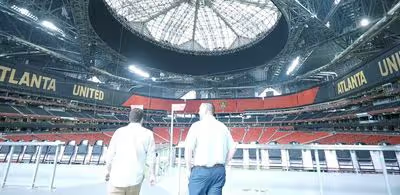
The project was a live test: indoor grass requires artificial sunlight, continuous monitoring and a final pitch swap to ensure peak playing surface when FIFA assumes exclusive control.
What was changed for soccer
The stadium retracted its corner seating to achieve full FIFA soccer dimensions, using pre-designed movable corners that preserve much of the bowl’s capacity while restoring proper field geometry. LED halo boards and the roof’s visual signature remain central to the fan experience, but much of the internal commercial signage was covered to comply with FIFA’s clean-site principle.
Support infrastructure was the heavy lift: new pumps, irrigation hookups, ventilation ducts and grow-light rigs were connected and stress-tested. Grounds crews treated the installation as a trial run—growing one pitch indoors while the tournament-ready sod remains outdoors to be installed fresh before FIFA’s exclusive period.
Operations and the roof: fan comfort vs. spectacle
The stadium’s operable eight-petal roof gives Mercedes-Benz a unique edge in event programming, but operational decisions will hinge on fan comfort and weather. Management has quantified limits: heat, humidity and winds above roughly 12–15 mph influence whether the roof will open.
Those thresholds matter more in Atlanta’s summer climate and could determine whether a World Cup semi-final is played under the open sky or the stadium’s canopy.
Opening the roof for a marquee match would heighten atmosphere, but it’s not an aesthetic call alone—engineering, player comfort and safety, and meteorological forecasts will govern the final decision.
Fan experience kept a priority
One striking commercial choice: the venue has preserved its fan-friendly pricing model for World Cup events, maintaining consistent concession prices and including refill policies on some beverages. That stance required negotiation around FIFA contracts, but it reflects a strategic commitment to accessibility that is rare for a global tournament setting.
Seat design and sightlines were also highlighted: the stadium’s 21-inch seating mandate and wide, unobstructed views remain selling points as organizers balance intimacy for soccer with the venue’s NFL-scale dimensions.
Why this matters: logistics, legacy and multi-purpose design
Converting an NFL/MLS facility into a World Cup-caliber soccer stadium is an exercise in systems integration. The work at Mercedes-Benz Stadium illustrates how modern venues must be amphibious—capable of switching playing surfaces, sightlines and commercial identities without compromising event frequency.
The fresh-sod strategy mitigates the main risk of indoor grass: photosynthetic stress. It’s a pragmatic acknowledgment that aesthetics alone don’t meet tournament standards—consistent performance under match conditions does.
Implications for teams and the event calendar
For Atlanta United and the Falcons, the conversion underscores how elite venues juggle tenant schedules. The stadium will continue to host MLS and NFL fixtures, concerts and college events, even as it prepares for the World Cup. An announced NWSL team arriving in 2028 and a new locker-room build signal longer-term soccer commitments that will benefit from these investments.
Tournament scheduling also adapts around climate: FIFA has shifted certain match windows to manage heat concerns, and stadium operators report those considerations have influenced broader tournament planning.
Final verdict: ambitious, necessary and fan-forward
The stadium’s approach is ambitious but methodical: pre-installed infrastructure, a controlled trial, and a fresh pitch swap before FIFA’s exclusive control protect competitive integrity. Operationally, the venue strikes a rare balance—meeting FIFA’s commercial restrictions while keeping concessions affordable and prioritizing sightlines and fan comfort.
Fox Sports adds Bob Bradley, ex-USMNT stars to FIFA World Cup 2026 broadcasts
If managed well, Mercedes-Benz Stadium’s conversion will be a blueprint for multi-use venues hosting major international tournaments. The real test arrives on match day, when engineering, groundskeeping and weather converge — and when the stadium must deliver both spectacle and a world-class playing surface.
 Si
Si