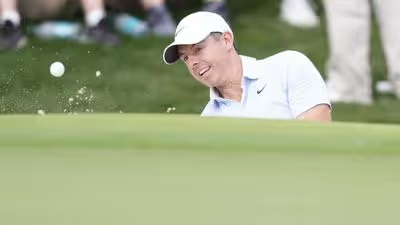
Rory McIlroy admitted he was wrong to back a deal that would bring Saudi Arabia’s Public Investment Fund into the PGA Tour partnership after PIF announced it will stop funding LIV Golf beyond this year. Speaking at Aronimink before the PGA Championship, McIlroy framed the shift as a cautionary lesson about geopolitics and the fragile money underpinning modern professional golf.
McIlroy reverses stance as PIF exit reshapes golf’s landscape
Rory McIlroy, at Aronimink ahead of the PGA Championship, said he was “glad I was wrong” about the idea of the Public Investment Fund (PIF) being a partner in the PGA Tour’s future. Once open to PIF involvement as a route to reunify golf, McIlroy now casts the fund’s withdrawal—announced this year and tied to its decision not to underwrite LIV Golf beyond 2024—as a reality check on relying on geopolitically linked capital.
What changed: PIF, LIV Golf and recent developments
PIF’s decision to step back from funding LIV Golf and the departure of Yasir Al-Rummayyan from the LIV board have left the rival league scrambling for alternatives. LIV CEO Scott O’Neil has said the league will seek new investors and sponsors after billions in PIF support since 2022. Meanwhile, the PGA Tour’s strategic investment from Strategic Sports Group — roughly $1.5 billion earlier this year — reshaped the Tour’s balance sheet but did not produce the PIF partnership some anticipated.
Why McIlroy’s shift matters
McIlroy is golf’s most influential active voice on institutional issues. His earlier endorsement of courting PIF was framed as pragmatic—getting the money into the game rather than letting it fuel division. His reversal signals a broader reckoning: high-profile players and administrators must weigh the optics and risks of capital tied to volatile international politics. That recalibration matters for governance, sponsorships and the long-term public perception of the sport.
Immediate impact on players and schedules
Players linked to LIV have been caught in the fallout. Jon Rahm, one of the LIV golfers in this week’s PGA field, described the PIF pullback as disorienting but said he trusts the league’s efforts to stabilize. LIV’s calendar has been disrupted: events continue in Asia and Europe but organizers have postponed or canceled others amid funding uncertainty. For players, that instability affects contracts, team operations and career planning.
Player sentiment and professional risk
Many golfers who joined LIV took a calculated financial and career risk. The sudden change in funding underscores how dependent the new league has been on one backer. That vulnerability leaves players exposed to rapid shifts—and raises questions about the sustainability of alternative tour models absent deep-pocketed, long-term investors.
What this means for the PGA Tour and reunification talk
The PIF exit complicates the narrative around reunification. McIlroy’s earlier point—that PIF money could have unified the sport if invested “the right way”—now reads differently: reunification cannot rest solely on the availability of one source of capital. The PGA Tour’s strengthened position after outside investment makes it less dependent on controversial partners, but the commercial pressures that birthed LIV remain.
Commercial reality versus sporting integrity
The episode exposes a tension: golf’s rapid cash infusion since LIV’s arrival has boosted purses, but it also forced stakeholders to decide how much ethical and geopolitical baggage they will accept for growth. McIlroy’s public U-turn reflects a pragmatic insistence that the sport manage both financial growth and its public legitimacy.
Looking ahead: scenarios and stakes
LIV will need new investors or sponsorship models to sustain its teams and global schedule. The PGA Tour, buoyed by new capital, can continue investing in purses and events that keep top players on its circuit. For players, the clearest path to stability is performance-driven value in whichever tour delivers consistent competition, television exposure and secure contracts.
What to watch next
Follow announcements from LIV about new funding or restructuring, any shifts in tournament schedules, and statements from top players about their long-term plans. Equally important will be how the PGA Tour positions itself commercially and ethically to retain public trust and the sport’s marquee talent.
Bottom line
PIF’s pullback has recalibrated the debate over outside investment in golf. McIlroy’s admission he was wrong to push for PIF involvement is significant—not just as contrition, but as a marker of how fragile the sport’s recent financial realignments are when exposed to geopolitical forces.
Tiger Woods, Phil Mickelson officially out of PGA Championship
The next phase will test whether golf’s competing models can find stable footing or whether uncertainty will persist for players and organizers.
 Si
Si