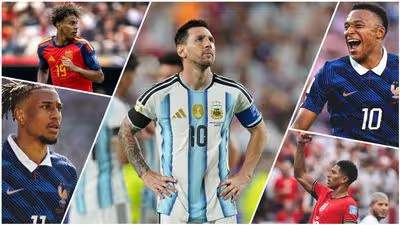
Four teams remain in the 2026 World Cup—France, Spain, Argentina and England—with two blockbuster semifinals in Dallas and Atlanta. Each squad carries a bona fide game-changer; this piece ranks the primary threats, explains why they matter tactically and psychologically, and outlines the matchups that will decide who reaches the final.
Semifinal schedule and stakes
France vs Spain — Tuesday, Dallas Argentina vs England — Wednesday, Atlanta
With the tournament entering knockout clarity, small margins and individual moments will decide everything. These semifinals pit generational talents against deep squads; the teams that best integrate their stars into a coherent plan will reach the final.
Top threats heading into the World Cup 2026 semifinals
8. Mikel Merino (Spain) — super-sub specialist
Merino has become Spain’s go-to late-game weapon, scoring decisive winners shortly after entering twice in the knockout rounds. His timing, calmness in the box and knack for arriving at the right moment give Spain an extra dimension when matches are stretched. France must guard against conceding space late; Merino’s influence is as much a tactical tweak as it is a psychological blow to opponents.
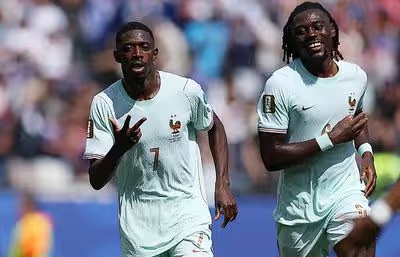
7. Ousmane Dembélé (France) — form and finishing
Dembélé arrived to this World Cup under pressure and has answered with goals and an attacking resurgence. When he’s confident, he stretches defenses on the flank and finishes chances; his recent scoring uptick has converted him from question mark to reliable outlet. Spain will need to limit his transition touches and isolate him from one-on-one opportunities.
6. Michael Olise (France) — creative fulcrum
Olise has orchestrated much of France’s attacking rhythm, threading passes and dictating transitions. Even when tightly marked, his vision creates overloads for teammates. Spain’s midfield will try to suffocate his influence early; if Olise finds space between the lines, France’s attack becomes far harder to contain.
5. Lamine Yamal (Spain) — raw talent with tempered output
Yamal remains a generational winger whose dribbling and tempo can unbalance any defense, though a spring hamstring issue has limited his full explosiveness. Opponents over-commit to neutralize him, which in turn creates opportunities elsewhere for Spain. France must choose whether to double-team him and risk overloads or shadow and concede wider angles.
4. Harry Kane (England) — the clinical focal point
Kane remains England’s relentless finishing engine and focal point of attack. His movement, aerial presence and penalty-box intelligence make him a constant threat against Argentina’s sometimes porous defense. Kane’s hold-up and finishing can pin back Argentine midfielders, but England will need service and midfield balance for him to operate at full effect.
3. Jude Bellingham (England) — match-turner in midfield
Bellingham has repeatedly turned games with his timing, shot quality and all-action midfield leadership. His recent braces underline an ability to deliver in high moments. For England, Bellingham is the emotional and tactical axis; neutralize him and you blunt England’s engine, but if he’s allowed to drive forward, he can single-handedly decide a semifinal.
2. Kylian Mbappé (France) — multi-faceted superstar
Mbappé remains the tournament’s most complete attacking weapon, combining elite pace with finishing and creative output. He’s not just a scorer; his assists and ability to drag defenders create space for others. France’s path to the final runs through him—stop Mbappé and you slow the whole French machine, but doing so is easier said than done.
1. Lionel Messi (Argentina) — still the ultimate difference-maker
At 39, Messi has defied expectations and reasserted himself as the tournament’s decisive figure. He has produced match-defining goals and the kind of leadership that elevates teammates. Argentina’s balance around Messi—players who press, run and finish—amplifies his impact. When he’s in form, Messi shifts tactical plans overnight; opponents must account for him every action, which opens avenues for Argentina’s supporting cast.
How these matchups shape up
France vs Spain will be a tactical chess match: Spain’s young, possession-driven approach versus France’s star-powered verticality. Control of midfield pockets (Olise vs Spain’s center) and managing the late-game threat from Merino are decisive factors.
Argentina vs England asks whether Messi’s creative genius and Argentina’s collective movement can outmatch England’s structure and the Bellingham–Kane axis. England must balance protecting against counter-runs from Messi while supplying Kane and freeing Bellingham.
What to watch
- Midfield control: whichever team dominates transition moments will likely control possession and scoring chances.
- Substitutions: super-subs and tactical changes could be the match-defining edges late on.
- Individual moments: with elite finishers on both sides, a single lapse or moment of brilliance can end a campaign.
Pochettino extension to 2030 signals US Soccer's shift to long-term program building
These semifinals aren’t just about tactics; they’ll test leadership, fitness and clutch temperament. The teams that blend tactical discipline with the ability to unleash their stars at the right time will book their place in the final.
 Si
Si