With the FIFA World Cup days away, attention shifts from off-field drama to seven players who could tilt the tournament’s balance — from Argentina’s Julian Álvarez stepping out of Messi’s shadow to Spain’s fitness-dependent Rodri, Portugal’s midfield engine Vitinha, and breakout threats like Yan Diomandé, Désiré Doué, Martin Ødegaard and Takefusa Kubo. Their form and fitness will shape which teams progress deep into North America.
Who will define the FIFA World Cup? Seven players to watch
The tournament’s favourites arrive with narratives beyond star names: transitions, fitness concerns and emerging talent. These seven players embody turning points for their nations — not headline glamour alone, but real determinants of how Argentina, Spain, Portugal, France, Norway, Côte d’Ivoire and Japan perform in North America.
Julian Álvarez — Argentina’s next-era catalyst
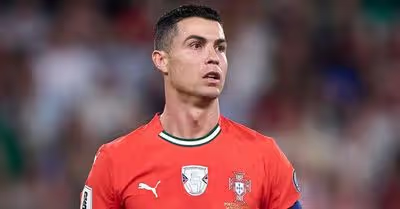
Julian Álvarez arrives as more than Messi’s understudy; he’s the forward who must help Argentina extend its global reign. After leaving Manchester City for consistent minutes and shining at Atlético Madrid, Álvarez combines high-intensity pressing with clever link-up play — attributes Argentina will need if Messi’s output dips with age or injury.
His Champions League pedigree shows he relishes big stages; this World Cup is the ideal platform to cement a post-Messi era rather than merely echo the past.
Yan Diomandé — Côte d’Ivoire’s youthful wild card
Nineteen-year-old Yan Diomandé is already a European sensation with RB Leipzig and could transform Côte d’Ivoire’s prospects. A dynamic dribbler on the right flank, he brings directness and unpredictability against Ecuador and Germany in a tricky group.
If Diomandé controls wide spaces and retains defensive discipline, Les Éléphants have a genuine chance to surpass previous campaigns and push into the knockout rounds for the first time in decades.
Rodri — Spain’s fitness fulcrum
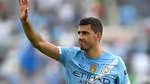
Spain’s tactical identity flows through Rodri. The Manchester City captain’s range of passing and positional intelligence underpin Luis de la Fuente’s balanced roster. Yet a gruelling club run and recent injury interruptions make Rodri a clear vulnerability: his availability will define Spain’s ceiling.
If he stays fit and logs heavy minutes, Spain can dominate tempo and progress deep; if not, possession control and midfield cohesion will erode, exposing the team to counterattacks.
Martin Ødegaard — Norway’s creative heartbeat
Norway’s tournament hinge isn’t solely Erling Haaland’s goals; it’s the creative spark of Martin Ødegaard. The Arsenal captain’s season was blighted by injury, limiting starts, but when fit he unlocks defenses with vision and timing. Ødegaard’s condition will determine whether Norway can convert Haaland’s finishing into a sustained run beyond the group stage. A fully fit Ødegaard turns Norway from a one-man threat into a collective one.
Vitinha — Portugal’s midfield engine
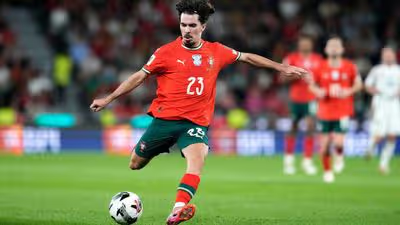
Vitinha has quietly become one of Europe’s premier midfield operators. Combining tempo control, sharp distribution and late runs, he orchestrates Portugal’s transitions while providing defensive cover. Arriving fresher than many peers, he could elevate Portugal’s balance between creativity and structure. When Vitinha functions as the straw that stirs the drink, Portugal’s talented forward line gains consistency; when he’s constrained, the team risks becoming fragmented.
Désiré Doué — France’s potential X-factor
France’s attacking depth is legendary, but Désiré Doué represents the sort of youthful ingenuity that can tilt decisive moments. Capable of producing match-changing moments from the wing or between lines, Doué could be an essential complement to Kylian Mbappé’s finishing. Didier Deschamps’ management of minutes will be crucial: if Doué earns consistent involvement, France’s attack becomes more unpredictable and harder to defend.
Takefusa Kubo — Japan’s creative spark
Takefusa Kubo carries the technical refinement and final pass that makes Japan a dangerous underdog. His trajectory — early moves across Spain’s elite academies and senior growth at Real Sociedad — honed a low-center-of-gravity dribbling game and a precise final ball. Alongside Ritsu Dōan, Kubo gives Japan the small-space inventiveness to punch above its weight and exploit moments against more physical opponents.
Why these players matter — tournament implications
Collectively, these seven encapsulate broader tournament dynamics: generational handovers (Álvarez), fitness as a limiting factor (Rodri, Ødegaard), midfield control (Vitinha), youthful unpredictability (Diomandé, Doué) and creative technical leadership (Kubo). Teams that secure midfield control and protect key playmakers will likely progress; those that do not will see individual brilliance neutralised.
What to watch in the group stage
Immediate indicators: Álvarez’s minutes and finishing frequency; Rodri and Ødegaard’s durability across 90+ minutes; Vitinha’s touches and passing completion in tight games; Diomandé and Kubo’s ability to produce end-product against experienced defenses. Early form will define tactical pivots and squad confidence heading into the knockout rounds.
Outlook — small details, big consequences
This World Cup could be remembered less for headline scorers and more for those who control rhythm, create moments and sustain intensity across a compressed schedule. Expect managers to protect fragile stars and to exploit opponents when these seven are off-balance.
Roma hoping to renegotiate financial fair play settlement agreement with UEFA
The teams that manage form, fitness and tactical clarity around these players will be the ones to watch as the tournament unfolds.
 Sportsnet