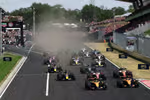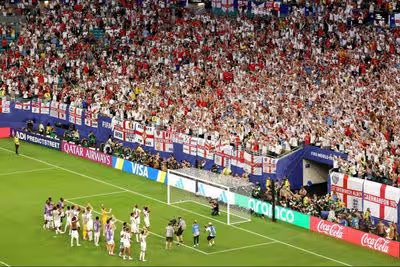
England vs Argentina has become the must-see semifinal at the 2026 World Cup, with last-minute resale prices far outpacing France vs Spain. Messi’s likely final World Cup run and the deep, historic rivalry with England have pushed get-in tickets into four-figure territory, while the France–Spain game—despite elite players—has seen demand and prices cool considerably.
England vs Argentina: the semifinal that became a cultural event
England against Argentina is shaping up as the headline act of the 2026 World Cup semifinals, and the market has noticed. Cheapest resale tickets for the Atlanta match jumped to roughly $3,000, with top-category seats selling out on the official ticket platform.

Demand is surging because this fixture combines Lionel Messi’s potentially last World Cup appearances, England’s long tournament drought, and a rivalry loaded with history and emotion.
Why Messi and meaning push prices higher
Messi turns every match into a global appointment. At 39, each World Cup appearance for him feels finite, and that scarcity translates directly into willingness to pay. Add England — a nation with a large U.S. expat community and easier travel links to Atlanta — and you have a perfect storm of accessibility, narrative and star power that has driven prices and frenzied fan planning.
France vs Spain: elite on paper, muted in the market
France vs Spain, played a day earlier near Dallas, has not provoked the same last-minute stampede. Get-in resale prices have fallen to roughly $1,400, and significant inventory remains across premium categories on the official platform. That gap is striking given the quality of players on display — Kylian Mbappé, Lamine Yamal and world-class squads — but context matters more than talent alone.
Why two superpowers aren’t selling out
Both France and Spain carry reputations for consistent deep runs; their semifinal appearances feel less like once-in-a-lifetime events and more like expected stops on elite trajectories. Recent continental success for Spain and multiple recent finals for France dampen the urgency. Logistical hurdles for traveling fans from Europe to Texas on short notice, and smaller expatriate communities locally, further reduce last-minute demand.
Key factors behind the ticket-price disparity
Historical rivalry: England–Argentina is steeped in dramatic World Cup moments and political overtones, including the 1986 and 1966 meetings. That narrative stokes emotion and makes the fixture feel epochal rather than routine.
Player narratives: Messi’s twilight-tour effect is measurable. England’s quest to reach a World Cup final for the first time since 1966 adds a complementary storyline that magnifies interest.
Accessibility: More frequent, cheaper direct flights and larger English-speaking expatriate populations in the U.S. make Atlanta comparatively easier for travelling fans than Dallas is for many Spanish or French supporters.
Market mechanics: Official late-ticket releases and resale listings are moving faster for the England–Argentina game, pushing category and get-in prices higher and creating a sense of scarcity that feeds itself.
What the numbers imply about fan behavior
The premium on England–Argentina signals that fans now pay not just for a match, but for a cultural moment. Willingness to pay large sums reflects the pairing of legacy narratives (rivalry, politics, past controversies) with present-day star power. For France–Spain, the market treats excellence as expected, not exceptional, in this cycle.
Consequences for the tournament and host cities
For Atlanta, packed stands and a charged atmosphere promise intense global attention and valuable economic activity. For Dallas and the France–Spain fixture, sparser crowds compared with the other semifinal could change the matchday vibe and the television narrative around which game felt like "the big one."
Organizers face trade-offs: balancing allocation fairness with the reality of uneven demand, managing security around a fixture with historical animus, and ensuring ticket access for fans who have saved months to attend.
What comes next
Atmosphere and media framing on matchday will likely validate why England–Argentina became the tournament’s hottest ticket. If Messi reaches the final, the match will be remembered as a pivot point in his World Cup legacy; if England advances, the payoff will be the end of a six-decade wait and a seismic moment for English football supporters.
Top-two showdown: USWNT host Spain in October friendlies; Crystal Dunn honored in D.C.
For France and Spain, the priority is competitive: whoever advances will have proven depth and pedigree. Market calm does not equal sporting insignificance — it simply reflects differing narratives and fan logistics at a unique, high-stakes moment in global football.
 Theathleticuk