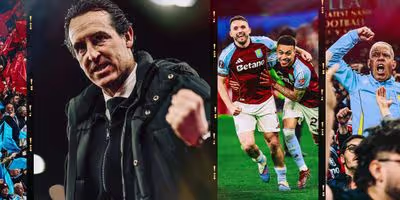
Aston Villa were crowned Europa League champions in Istanbul, defeating Freiburg at Besiktas Park to win the club’s first major trophy in 30 years and Unai Emery his fifth Europa League crown. The triumph secures Champions League football, elevates Emery into Villa folklore and forces an urgent summer focus on recruitment and squad depth if the club are to compete at Europe’s highest level.
Aston Villa crowned Europa League champions in Istanbul
John McGinn lifted the trophy as Aston Villa completed a season-defining victory over Freiburg in front of raucous travelling supporters at Besiktas Park. Unai Emery’s side not only claimed European silverware but also guaranteed Champions League football, ending a long wait for major honours and transforming the club’s trajectory.

How a fragile early season became a continental triumph
The campaign began under strain: poor early Premier League results, financial constraints across the summer and a squad stretched thin by European commitments. Criticism of preparation and travel routines surfaced, and several senior players openly considered their futures. Yet Emery’s discipline and structure kept the project intact.
Emery’s management held the line
Emery’s exacting methods—long training sessions, tight tactical instruction and a core coaching group drawn from Spain—created friction but also consistency. Those methods were tested by fixture overload, limited summer investment and a period of poor form, but ultimately they delivered cohesion when it mattered.
Europa League was the catalyst
Early group-stage victories rebuilt confidence and gave Villa a platform away from the pressures of the Premier League. Emery frequently used a conservative away-first-leg approach and then opened his team in return fixtures, a pattern that paid dividends through the knockout phase.
Key knockout moments
Villa navigated ties against the likes of Bologna and Lille with tactical nous and controlled game management. A setback at Nottingham Forest in the semi-final first leg was answered with a dominant home performance to seal progression, and a decisive run of results in the spring set the tone for Istanbul.
Players who defined the run
John McGinn’s leadership and the attacking link between Ollie Watkins and Morgan Rogers carried Villa in key moments. Youri Tielemans provided moments of individual brilliance, while Emiliano Martínez’s distribution and Matty Cash’s reliability were vital. Bouba Kamara’s form before his knee injury had been especially influential.
Injuries, dips and resilience
A triple blow in January—Kamara, Tielemans and McGinn sidelined in quick succession—triggered a midseason wobble that exposed depth issues. The squad’s response, however, highlighted the trust players place in Emery’s system and the character within the dressing room.
Tactical blueprint: pragmatism with a razor-edge
Emery’s preferred 4-2-2-2 shape offered balance: two compact midfield screens, creative outlets in the inside channels and two forwards who could press and finish. Set-piece preparation and detailed opposition analysis produced the fine margins—Villa’s late-season goals often came from rehearsed patterns rather than lucky breaks.
What the trophy means for Emery and Villa
This is another feather in Emery’s cap: a fifth Europa League title that cements his reputation as the competition’s pre-eminent coach. For Aston Villa it is validation of medium-term strategy—sporting progression, improved squad identity and the commercial and competitive benefits of Champions League qualification.
Legacy and leverage
Emery’s autonomy at Villa, including an established technical staff, has been rewarded. The trophy strengthens his standing internally and globally, making it likelier the club can retain key staff and players going into a more demanding season.
Immediate priorities: recruitment and squad management
Champions League football raises standards and fixture load, and Villa’s summer must focus on meaningful reinforcements—particularly in forward depth and midfield rotation. Contract negotiations, aging profiles in parts of the squad and the need to balance continuity with upgrades are immediate challenges for the sporting hierarchy.
Financial context and opportunity
European progression will ease some financial strain but also raises expectations. Smart recruitment and player retention will determine whether Villa can turn a one-off cup win into sustained continental competitiveness.
What comes next
On the pitch, Villa must translate European momentum into consistent domestic form to avoid a repeat of midseason dips. Off it, the club must capitalise on the victory to build sustainable depth and protect the manager’s project.
Roma interested in Nusa, Summerville and Greenwood
This Europa League triumph is both destination and starting point: glory achieved, but the work to compete with Europe’s elite has only just begun.
 Theathleticuk