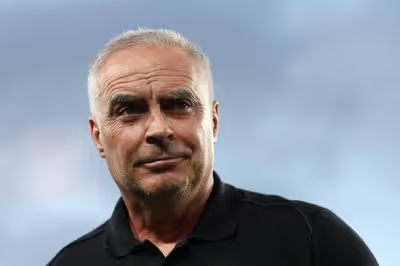
Darren Bazeley will become the first men’s coach to manage at U17 and U20 World Cups, the Olympics and a senior World Cup when New Zealand open Group G v Iran on June 15 in Los Angeles. The All Whites arrive as underdogs but a squad built on long-term relationships — led by captain Chris Wood — gives New Zealand a cohesive, pragmatic path to punch above their 85th-ranked status.
Bazeley’s unique coaching milestone and why it matters
Darren Bazeley arrives in the United States poised to make coaching history: no other men’s national-team boss has combined U17 and U20 World Cups, an Olympics and a senior World Cup on their résumé. That’s not a vanity stat — it encapsulates the continuity and developmental clarity underpinning New Zealand’s approach to Qatar (sic) this summer.

Bazeley’s pathway through youth tournaments into the senior game is a blueprint for smaller federations seeking progress through long-term culture-building.
From lower-league full-back to national architect
Bazeley’s playing career — spells at Watford, Wolves and Walsall — never promised this outcome. A move to New Zealand in the mid-2000s shifted his trajectory from journeyman full-back to a coach steeped in the country’s youth structures. He became a citizen, stayed embedded in the federation, and gradually assumed greater responsibility, moving from youth age-groups into senior management. That depth of institutional knowledge is now New Zealand’s strategic advantage.
All Whites squad: continuity over flash
New Zealand’s 26-man squad is tightly knit. Many players progressed through the same clubs, national age-group teams and school programmes. Eight squad members play domestically for Wellington or Auckland, another is with Newcastle Jets in Australia, and several others have long histories with Bazeley dating back to adolescence. That continuity matters for a team ranked 85th by FIFA: when talent depth is limited, cohesion and a shared identity can substitute for elite personnel.
Why continuity can compensate for limited depth
Small federations can’t stockpile elite professionals. New Zealand’s answer has been consistency in selection and style. Bazeley has coached many squad members at U17 and U20 World Cups, so tactical familiarity and trust are established. In tight international windows — often three or four training sessions — that trust shortens the learning curve. For tournament football, where margins are thin, a team that instinctively understands roles and pressing triggers gains tangible minutes on the pitch.
Staffing, scouting and logistical constraints
New Zealand travels with a compact full-time staff augmented by contractors for tournaments: physios, a doctor, sports scientists, a psychologist and specialist coaches. Simon Elliott, a former captain with World Cup experience, brings veteran All Whites credibility from his coaching base in the United States. Scouting is often video-driven, compiled by the federation’s performance analyst, with occasional in-person scouting trips for Europe- and Americas-based players.
Practical limits that shape strategy
Limited windows and intermittent training force a pragmatic tactical approach. Bazeley admits New Zealand can’t constantly reinvent its playbook; instead, the team prioritises a stable style, clear defensive organisation and set-piece efficiency. That pragmatic consistency is both realistic and potentially disruptive to opponents who underestimate the All Whites’ structural coherence.
Chris Wood: captain, talisman, culture carrier
Chris Wood remains New Zealand’s linchpin. The Nottingham Forest striker is the national captain, all-time top scorer (45) and joint-most-capped player. Beyond goals, Wood’s behaviour sets standards: he is industrious, humble and visibly present with fans and teammates. His Premier League form — including a 20+ goal season recently — offers both scoring potential and the leadership that binds this squad.
Form, warm-ups and warning signs
New Zealand’s final friendlies have been uneven. A heavy 4-0 defeat to Haiti in Fort Lauderdale exposed defensive frailties and a lack of intensity, a result Bazeley called a “harsh lesson.” A high-profile warm-up against England offers a sterner test before the Iran opener on June 15 in Los Angeles. Those matches will refine selection choices and tactical tweaks but also underscore the gulf in training volume and match sharpness between the All Whites and top-tier nations.
Historical context and tournament aims
New Zealand’s World Cup history is compact but respectable. Spain 1982 produced the nation’s first finals goal; South Africa 2010 yielded three draws and the rare distinction of finishing a group unbeaten. That unbeaten legacy remains technically intact, but the prevailing aim is pragmatic advancement: secure results in Group G, maximise points against comparable opponents, and push for a first knockout appearance. Bazeley’s prior knockout success with New Zealand’s youth sides provides a template, not a promise.
Realistic objectives
Given the squad’s rank and resource limits, the clearest priorities are defensive solidity, exploiting set pieces, and getting the best out of Wood in and around the box. Progression to the knockout stage would require perfect execution, plus at least one decisive result early in the group. For a federation that builds methodically, even a tightly contested draw or an upset win would be a substantive achievement.
What happens next — the practical outlook
New Zealand’s calendar is clear: final warm-ups in the United States, then the Group G opener with Iran on June 15. Expect Bazeley to lean on familiarity: predictable selections, compact defensive structure, and targeted offensive moments centred on Wood and set-piece routines. The squad’s emotional cohesion could translate into overperformance if discipline and fitness hold up.
Bottom line
Bazeley’s World Cup presence is a milestone for both coach and federation — a vindication of long-term player development and selection stability. The All Whites won’t be fancied on rankings or reputation, but their cohesion, leadership and tactical pragmatism create a clear, credible path to potential success.
16 players who could use World Cup to get a big tr...
How far New Zealand can go will hinge on discipline, marginal tactical improvements from the warm-ups, and whether Chris Wood can convert leadership into decisive goals.
 Theathleticuk