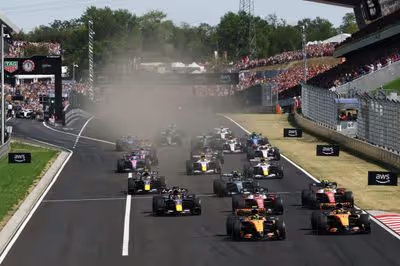
F1 should heed five clear lessons from the World Cup: calendar expansion risks exhaustion, post-event reversals expose stewarding fragility, fans hunger for underdogs, in-race stoppages and ad-driven pauses are becoming normalized, and skyrocketing ticket prices risk eroding goodwill. At the same time, a debate over simplified broadcasts — boosted by George Lucas’s comments and Stefano Domenicali’s defense — clashes with calls for more technical transparency as COTA prepares for record US Grand Prix crowds.
F1’s biggest takeaways from the World Cup
The World Cup’s theatre of drama and disruption offers immediate lessons for Formula 1 as it juggles a longer calendar, bigger commercial ambitions and an evolving fan base.

1. Calendar creep invites burnout
Teams, drivers and track crews are operating on thinner margins after consecutive long seasons. The World Cup’s packed schedule reinforced a simple truth: more events mean more fatigue. F1’s 24-race seasons and earlier testing windows are producing the same strain. That has real consequences for performance, safety and personnel retention.
2. Post-event reversals damage credibility
VAR controversies and high-profile red-card reversals show how modern sport’s outcomes can be unsettled long after the final whistle. F1 already lives with post-race stewarding and appeals that can strip podiums or alter championships days later. That uncertainty undermines the moment-to-moment drama fans tune in for and calls for clearer, faster adjudication.
3. Fans love an underdog narrative
Expanding the field at a global tournament didn’t dilute the quality at the top; it created new stories and broadened engagement. F1’s competitiveness problem isn’t just technical — it’s narrative. Measures that nudge closer contests (resource allocation, spending rules or team structures) could revive interest without sacrificing the sport’s engineering pinnacle.
4. Commercial pauses become normalized
Hydration breaks and broadcast-friendly stoppages are now part of mainstream sports production. As heat and safety concerns rise, F1 may face more in-race interruptions framed as welfare measures — and broadcasters will monetize those windows. That shift alters the flow of a race and the fan experience in subtle but meaningful ways.
5. Price inflation risks a backlash
Record ticket revenues don’t guarantee long-term goodwill. Skyrocketing prices can drive short-term gains while fracturing the sport’s traditional fan base. The World Cup’s governance crisis is a cautionary tale: commercial strategies that ignore supporter sentiment create political and reputational costs that are hard to reverse.
George Lucas, Stefano Domenicali and the broadcast philosophy
A high-profile endorsement of simplified broadcasts has rekindled a debate about how much technical detail should appear on-screen. George Lucas reportedly argued that new fans care about spectacle — the overtakes and action — rather than the mechanics. F1’s leadership leaned on that point to justify dialling back some telemetry, including battery-charge displays.
Why this matters
Simpler broadcasts can attract casual viewers and preserve the drama of wheel-to-wheel racing. But stripping away technical context risks alienating engaged fans who appreciate strategy, energy-management battles and the engineering chess match. The sport faces a balancing act: grow the audience while keeping its technical soul visible.
Analyst take
The right approach is layered coverage: offer a clean, cinematic primary feed for mainstream viewers and richer data channels for dedicated fans. F1’s platforms and broadcaster partnerships should enable this, not force a one-size-fits-all presentation.
Circuit of The Americas braces for a record United States Grand Prix
Circuit of The Americas (COTA) is projecting its biggest US Grand Prix yet, with prior weekends breaking 400,000 in attendance and momentum pointing higher. Organizers are planning logistical upgrades — road improvements and expanded access — and adding Thursday activations such as Grand PrixView days with support-category action and pit-lane experiences.
Operational pressures and opportunities
Higher attendance is a win for revenue and spectacle, but it amplifies concerns already familiar to F1: transport capacity, local infrastructure, safety, and fan affordability. If COTA executes successfully, the US market will solidify its place as a cornerstone event; if logistics falter, the reputational cost could be steep.
What this all means for teams, fans and the calendar
The convergence of sporting, commercial and broadcast trends creates a pivotal moment for F1.
Key implications:
- Sporting integrity: Faster, clearer stewarding decisions are necessary to protect race-day drama.
- Competitive balance: Incremental regulatory changes can preserve technological excellence while widening the contest.
- Fan strategy: Segmented broadcast products and price-sensitive ticketing will be essential to sustain growth without alienating core supporters.
What to watch next
- How governing bodies reform post-race review timelines and transparency.
- Any adjustments to resource allocation or spending rules aimed at tightening the field.
- COTA’s operational plans and whether added access days broaden attendance demographics.
- Broadcast experiments that test layered feeds or optional telemetry for viewers.
Hungaroring names Turn Two after Lewis Hamilton as F1 considers Sepang return
F1 is at an inflection point where lessons from another sport are directly applicable. The choices made now — about scheduling, broadcast presentation and fan economics — will shape whether growth is sustainable or brittle.
 Theathleticuk