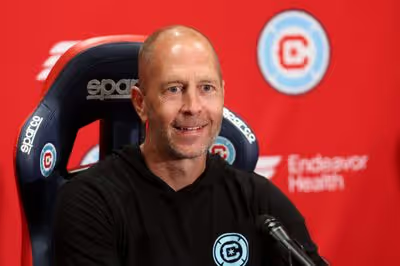
Gregg Berhalter, now Chicago Fire head coach and sporting director, hosted both the U.S. and Germany at the club’s training complex ahead of the World Cup — a symbolic homecoming that underscores his lasting influence on the U.S. roster he helped rebuild. His presence ties the program’s past development to a group now entering its prime as the U.S. opens Group D on June 12.
Berhalter hosts U.S. and Germany at Chicago Fire — why it matters
Gregg Berhalter’s role as host for both the U.S. men’s national team and visiting Germany at the Chicago Fire facility is more than a PR touchpoint; it’s a statement about continuity. Once the architect of the modern U.S. rebuild, Berhalter now watches from MLS as a developer of the very players heading to the World Cup. That proximity underlines how much of the current squad still reflects his philosophy.
Berhalter was dismissed from the national team in mid-2024 and later hired by the Fire as head coach and sporting director. The transition from national coach to MLS leader is unusual, but his presence around the national group — and his son, Sebastian, who has broken into the squad — keeps him linked to the USMNT story heading into the tournament.
A fitting irony and a living legacy
There’s historical irony in hosting Germany at a site where Berhalter now works: his most famous World Cup moment as a player came versus Germany in 2002. Beyond the anecdote, his fingerprints are visible across a roster that was intentionally built for the 2026 cycle. The U.S. team that will kick off Group D on June 12 has matured from a young, developmental unit into a core of players now in their mid-20s — Christian Pulisic, Tyler Adams, Weston McKennie among them — entering their primes.
Berhalter’s development-focused tenure helped create the environment where these players honed professional habits and tactical understanding. That formative influence matters not only tactically but culturally; he helped instill standards that persist under Mauricio Pochettino.
Who in the squad traces back to Berhalter’s tenure
Several leaders in the current roster were molded during Berhalter’s time in charge. Christian Pulisic (27), Tyler Adams (27), Weston McKennie (27), Tim Weah (26), Antonee Robinson (28) and Sergiño Dest (25) represent a cohort that moved from raw talent to international stalwarts under Berhalter’s watch.
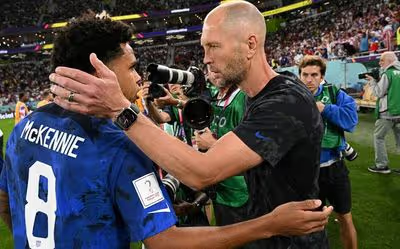
Players speak to the personal side of the relationship. McKennie, for example, has described Berhalter as someone he trusted through highs and lows — a sign of the coach’s role as a stabilizer and mentor. That mutual respect helps explain why Berhalter remains a visible, supportive figure rather than a detached former coach.
From developer to domestic coach — what that shift means
Berhalter’s shift to the Fire has two practical effects. First, it keeps him in daily contact with a generation of players and coaches, reinforcing his familiarity with MLS trends and player development. Second, his dual role as head coach and sporting director allows him to shape club infrastructure in ways that mirror his national-team priorities: tactical discipline, youth pathways and professional standards.
For the U.S. program, the outcome is largely positive: continuity in philosophy, a deepening of the professional pipeline, and a reminder that the U.S. rebuild was not accidental but the product of deliberate planning.
Impact on World Cup prospects
On the field, Berhalter’s presence is a morale boost and an informational asset. Players who grew up in his system benefit from continuity in expectations and an emotional anchor at a high-pressure moment. That familiarity can translate into composure in first-round matches.
Strategically, the core he helped develop is now mature enough to aim beyond the round-of-16 benchmark. Whether the team achieves that will depend on execution and Pochettino’s tactical imprint, but the groundwork laid by Berhalter removes a key developmental variable: the players’ readiness.
What to watch in Chicago and beyond
Team cohesion and mental readiness will be under the microscope here. Expect the U.S. to display clarity in structure and leadership from the experienced mid-20s cohort. Sebastian Berhalter’s inclusion in the squad and Chris Brady’s role with the Fire are reminders that MLS remains a meaningful contributor to U.S. depth.
Tactically, watch how set-piece organization, defensive shape and midfield transitions — areas emphasized during Berhalter’s tenure — hold up against elite competition. Those details could determine whether the U.S. advances from a winnable Group D.
Bottom line
Berhalter hosting the U.S. and Germany at the Chicago Fire is more than a photo-op. It’s a tangible reminder that the current U.S. team is the product of a deliberate rebuild that began years ago and is now coming of age. The coaching transition to Mauricio Pochettino introduces new variables, but the squad’s core is battle-tested, professionally grounded and ready to be judged on the World Cup stage.
What comes next will tell us whether that long-term work translates into tournament progress.
 Theathleticuk