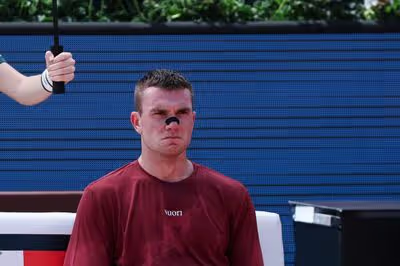
Jack Draper will miss the rest of the clay season with a right knee tendon injury, withdrawing from the Italian Open and Roland Garros; he plans to prioritise recovery and target the grass season, a move that risks a sharp ranking drop but protects his long-term prospects ahead of Wimbledon.
Draper ruled out of clay season after right knee tendon injury
Jack Draper confirmed he will skip the Italian Open and the French Open after sustaining a right knee tendon issue that forced his retirement in Barcelona against Tomás Martín Etcheverry. Draper said his knee is "on the mend" but that medical advice was clear: avoid rushing into five-set clay-court tennis. He intends to return for grass season, which begins with Stuttgart and culminates in Wimbledon.

Immediate impact: tournaments and rankings
Draper's withdrawal removes him from two of the biggest clay events — the Rome Masters and Roland Garros — and leaves his schedule focused on recovery and a grass-court return. By the end of the clay swing he will defend few points, leaving him with around 560 ranking points and a projected position outside the men’s top 100, a fall from his career-high No. 4 in June 2025.
How the injury unfolded
The knee problem culminated in retirement during his Barcelona match with Etcheverry. This latest setback compounds a year of fitness trouble: last season Draper suffered an arm bone bruise that curtailed his campaign after a breakthrough run to the Madrid Open final and a top-5 ranking. He returned in February, beating Novak Djokovic en route to the Indian Wells quarterfinals, but has only played twice since — a loss to Daniil Medvedev and the Barcelona retirement.
Why skipping Roland Garros is a defensible choice
Clay-court Grand Slams demand prolonged physical resilience; best-of-five matches magnify any conditioning gap. Opting out of Roland Garros is cautious but sensible: it reduces the risk of aggravation and allows Draper to build strength and match fitness in a targeted pre-grass window. For a player who relies on explosive movement and a heavy serve, entering Wimbledon fully fit is strategically more valuable than a hurried return on clay.
Where he might return: Stuttgart or Queen's
Stuttgart (ATP 250) — where Draper claimed his first tour title in 2024 — is the obvious staging ground for a comeback, starting June 8. Queen's Club (ATP 500) the week after offers a higher-tier warm-up nearer home. Either choice signals a focused, surface-specific rehabilitation plan: short hard-court/grass tune-ups rather than a grinding clay rebuild.
What this means for Draper’s career trajectory
The ranking drop will be stark on paper, but it need not define his medium-term prospects. Losing seed protection increases the difficulty of early draws, but a concentrated, healthy grass season could restore confidence and momentum. Draper’s recent results — notably the Djokovic scalp at Indian Wells — show the ceiling remains high; the immediate priority is preserving that potential through measured recovery.
Implications for British tennis and Wimbledon
As Britain’s most prominent young male talent, Draper’s absence from Roland Garros is a blow to national hopes on clay, but his focus on Wimbledon aligns with both personal and public interest. He has yet to clear the second round at SW19; a fully fit Draper poses a more credible threat than a partially recovered version risking deeper injury on clay.
Outlook and what to watch next
Monitor entry lists for Stuttgart and Queen’s and any updates on Draper’s rehabilitation timetable. Key indicators will be his workload in practice, responses to prolonged hitting, and a progressive match schedule rather than a single rushed reappearance.
Iga Swiatek retired against Ann Li in the Madrid Open
If handled conservatively, this interruption could be the reset Draper needs to recapture the form that vaulted him into the top five.
 Theathleticuk