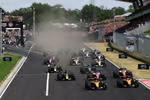
Charles Leclerc seized a dramatic British GP victory at Silverstone after Mercedes’ Kimi Antonelli saw a commanding performance collapse when a damaged wheel shield ruined his chances. Max Verstappen’s late spin and removal under the safety car, combined with the FIA’s correct application of the lapped-cars rule, prevented a final-lap shootout — leaving strategy, car design reliability and the sport’s restart rules under renewed scrutiny.
Leclerc triumphs at Silverstone as Mercedes' race unravels
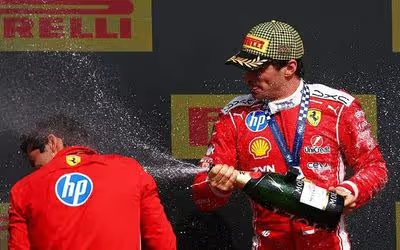
Charles Leclerc converted pole into a decisive win at the British Grand Prix, capitalizing on opportunity and staying clear of late chaos. Kimi Antonelli had driven the fastest Mercedes all day and looked set to leap into a commanding championship lead, only for a damaged left-front wheel shield — caused by a curb impact — to finish his race ambitions. The result reshuffles momentum in the title fight of the F1 and exposes fresh reliability concerns for Mercedes.
Race-defining moments
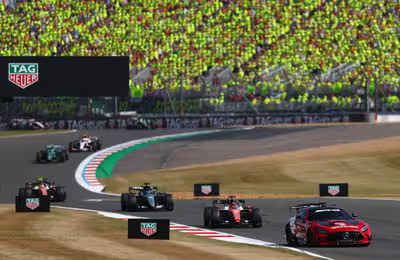
Max Verstappen’s spin into the Stowe gravel on Lap 47 brought out the safety car and set the endgame. Recovery crews worked for nearly three laps to remove Verstappen’s Red Bull. The FIA permitted lapped cars to unlap as allowed under the rules, but because the unlapping occurred late, the safety car stayed out until the checkered flag — eliminating any chance of a one-lap shootout.
Hamilton pitted under that safety car for soft tires but could not force a dramatic finish. George Russell, kept out on older rubber by Mercedes, preserved track position and finished ahead of Hamilton, leaving Russell’s gamble vindicated by procedure rather than pace.
Why the safety car ending mattered
F1’s rules on lapped cars — correctly applied here — require that if lapped cars are allowed to overtake, the safety car returns to the pits at the end of the following lap. Because that process began so late, there simply wasn’t a lap left to restart. The result was unsatisfying for the crowd hoping for a spectacle, but procedurally sound. The episode again exposes the tension between sporting theatre and regulatory consistency: drivers and fans want drama; officials must prioritize safety and rule adherence.
Red Bull’s aero concept under the microscope
Verstappen’s crash was not a simple driver error. Red Bull’s novel take on a rotating rear-wing concept — designed to open up more and dump drag for extra straight-line speed — appears to have a reattachment problem. Twice in recent races that system has failed to reestablish airflow correctly, pitching the car off balance. On a circuit like Silverstone, with high-speed kerb impacts and narrow margins for error, that kind of intermittent behaviour is dangerous and demands an urgent technical response from Red Bull.
Mercedes: pace compromised by component fragility
Mercedes looked fastest through the weekend, but Antonelli’s wheel-shield failure from a curb strike was a blunt reminder that outright speed means little without component robustness. That failure turned a potential dominant 55-point swing in the standings into costly damage limitation. Meanwhile, Mercedes’ split strategy — pitting Hamilton while keeping Russell out — paid off in finishing order but left Hamilton and the home crowd frustrated. The team’s strategic flexibility remains an asset, but repeated reliability hiccups cannot be papered over by tactics.
Horner’s return and the paddock narrative
Christian Horner’s presence in the paddock drew attention independent of the race itself. His high-profile return underscores how personalities still shape F1’s storylines off track. Whether he appears as a spectator, potential investor, or author, the sport’s ecosystem continues to orbit its most prominent figures — for better or worse.
What this means for the championship
Leclerc’s win tightens the title picture and proves Ferrari can seize advantage when rivals falter. Mercedes offers the raw pace to challenge for wins, but component fragility and strategic calls will determine whether that potential translates into sustained points gains. Red Bull’s aerodynamic gamble gives them a top-speed edge on paper, but reliability lapses will blunt championship aspirations if not fixed quickly.
Where teams must respond
- Mercedes needs to prioritize durability on street-rough and high-kerb circuits; small bits become season-altering failures. - Red Bull must re-evaluate the rotating wing implementation to eliminate catastrophic reattachment issues. - The FIA should review end-of-race communications systems after an erroneous “safety car in this lap” message muddied expectations, even if it didn’t change the procedural outcome.
Looking ahead
Silverstone leaves the sport at a tactical inflection point: regulatory clarity beat theatricality this time, but persistent technical failures threaten to decide championship battles off the track rather than on it.
Leclerc's Silverstone Revival: Ferrari Restores Momentum with Big Win
Expect teams to push for quick fixes over the next rounds — both to hardware and to operational processes — and for the championship narrative to hinge as much on engineering responses as driver form.
 Theathleticuk