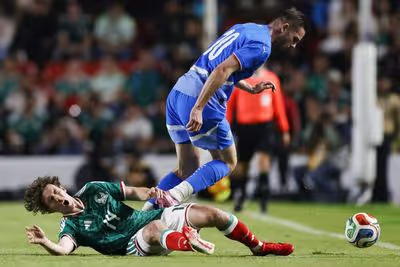
Marcel Ruiz is racing against the clock after a partially torn right ACL and damaged medial meniscus at Snapdragon Stadium; he delayed surgery to chase a Mexico World Cup spot, leaving Toluca and coach Javier Aguirre to weigh a high-stakes gamble between a potentially decisive midfield presence and the risk of an unfit selection on football’s biggest stage.
Ruiz’s injury and the World Cup gamble
Marcel Ruiz suffered a partial tear to his right anterior cruciate ligament and damage to his medial meniscus in early March at Snapdragon Stadium, throwing his World Cup ambitions into turmoil. Toluca confirmed the knee injury, but Ruiz opted to postpone reconstructive surgery and pursue an accelerated rehabilitation program aimed at making Mexico’s squad for the tournament this summer.
Why the decision matters
Choosing rehab over immediate surgery is a calculated risk: it preserves any chance Ruiz has to participate in the World Cup but increases the odds of aggravation and long-term consequences. For Mexico, the calculus is binary — include a talented but compromised midfielder, or select a fully fit alternative who may lack Ruiz’s blend of size, passing and box-to-box range.
Player profile: what Mexico would miss
Ruiz, 25, has emerged as a consistent, possession-oriented central midfielder for both Toluca and Mexico, earning 17 senior caps and growing into a key role over the past two seasons. Comfortable progressing play on the dribble, pressing aggressively and timing late runs into the box, he offers something difficult to replicate: a midfielder who blends defensive heft with creative instincts.
Timeline: injury, diagnosis and return
Ruiz was hurt in March and Toluca later confirmed the ACL and meniscus damage. Rather than undergoing immediate surgery, he followed an intensive rehabilitation plan and returned to game action in mid-April, coming on late in a Concacaf club match and then appearing as a second-half substitute against Club América at the Estadio Azteca.
How he looked on his return
On his first appearances back Ruiz displayed technical sharpness and tidy ball control but was noticeably cautious in physical duels and sprinting without the ball. He reduced risky 50-50 challenges and defended more by positioning than contact — sensible short-term management, but not full match fitness by the standards expected at a World Cup.
Managerial stance: Aguirre’s selection standard
Mexico coach Javier Aguirre has been explicit about fitness requirements: players must be fully fit and participating in competitive training to be considered. Aguirre’s public stance increases scrutiny on any inclusion of an injured player and frames Ruiz’s situation as both a medical and managerial dilemma rather than merely a personal crusade.
Squad implications
Mexico boasts depth in midfield, which complicates the decision to risk a selection based on potential rather than current availability. Selecting Ruiz would signal confidence in his recovery plan and a willingness to prioritize tactical fit. Omitting him would favor short-term reliability but might deprive the team of a player who offers distinct dynamism when fully healthy.
Historical precedents and context
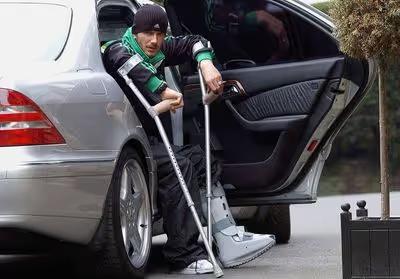
Previous World Cups have seen players return from significant injuries — David Beckham in 2002, Wayne Rooney and Ashley Cole in 2006 and 2010, Cesc Fàbregas in 2010 — with mixed outcomes. Those cases show that accelerated recoveries can succeed, but they also underscore the unpredictability of form post-injury. Ruiz’s knee injury is arguably more delicate than many metatarsal or hairline fractures, making parallels useful but imperfect.
What comes next
Mexico plans to release a partial squad list drawn from Liga MX players this week; Ruiz is expected to be included on that list. The decision will be a high-stakes signal: inclusion suggests the coaching staff trusts the medical update and rehabilitation progress; exclusion would indicate a preference for guaranteed fitness. Ultimately, Ruiz’s presence in the final 23 (or expanded tournament roster) will depend on measurable match fitness and the coaching staff’s appetite for risk.
Why this matters for Mexico
The choice over Ruiz highlights a broader selection philosophy — whether Mexico will prioritize immediate physical readiness or tactical nuance that a specific player brings. On a tournament stage where margins are fine, the outcome of this gamble could tilt Mexico’s midfield identity: conservative and durable, or technically refined but medically fragile.
Bottom line
Ruiz’s comeback is a compelling subplot in Mexico’s World Cup build-up. It tests medical teams, coaching conviction and the player’s own resilience.
The brilliant Robert Lewandowski is facing a career without a fitting curtain call
If he returns to full capacity, Mexico gains a versatile midfielder capable of influencing games. If not, the decision to include him will be judged harshly in real time.
 Theathleticuk