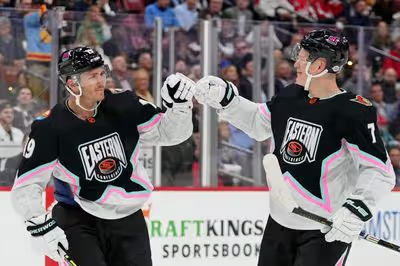
The NHL offseason has erupted into a frenzy of blockbuster trades, driven by a thin free-agent class, cap pressures and empowered stars dictating destinations. Early movers — Buffalo, San Jose and Florida — appear to have profited handsomely, while Chicago’s aggressive price for Bowen Byram and Connor Bedard’s lack of top-line support highlight the downside risk. The market is shifting fast; more high-profile names remain unresolved and could reshape contenders before training camps open.
Why the NHL offseason is suddenly chaotic
Teams are reacting to a rare combination: one of the weakest free-agent classes in recent memory, tight salary-cap math, and players wielding no-trade/no-movement leverage. That triple threat forces franchises to trade assets rather than sign expensive free agents, accelerating deal flow and inflating prices for available talent. The result: rapid, high-stakes roster turnover and an increased premium on first-round picks and controllable players.

Market-moving trades and the immediate winners
Buffalo Sabres: Asset conversion at its finest
Trading Bowen Byram for multiple high-value assets — including a top-5 pick and depth pieces — ranks as one of the smarter deadline-to-offseason pivots. With Rasmus Dahlin and Owen Power entrenched and significant cap commitments looming, Buffalo avoided a costly extension and converted a potentially overpaid commitment into futures and flexibility. That haul gives Buffalo ammunition to reload through the draft or swing for a premium acquisition.
Bowen Byram: Opportunity and leverage
Byram lands in Chicago where ice time and role are guaranteed. He arrives with leverage as a pending unrestricted free agent, and Chicago’s cap space creates a favorable negotiation environment. From a career and financial standpoint, the move should materially improve Byram’s prospects.
Florida Panthers: The Tkachuk brothers and the top-heavy attack
Acquiring Brady Tkachuk to join Matthew Tkachuk — likely alongside Sam Bennett — immediately creates a top-nine nightmare for opponents and one of the most potent forward groups in the salary-cap era. Florida’s willingness to spend draft capital paid off, and the club’s aggressive construction signals a win-now identity.
San Jose Sharks: Smart inventory management
San Jose’s moves — trading down to pick Kesselring cheaply and flipping William Eklund for a top-10 pick — keep the prospect cupboard full while giving flexibility to address the blue line. Stacking picks around players like Macklin Celebrini and Will Smith preserves optionality: draft high-end defense or package picks for an established blueliner.
St. Louis Blues: Turning Kyrou into long-term value
Moving Jordan Kyrou yielded younger assets, a mid-first-round pick and multiple selections. That approach replenishes St. Louis’s draft currency and cap flexibility, positioning them to be active buyers on the trade market or rebuild around a fresh core.
Washington Capitals: Calculated price for elite winger
Washington paid a premium for Kyrou but did so from a position of having banked assets earlier in the year. The Capitals’ deadline decisions created the optionality necessary to pursue a proven top-six winger, balancing immediate scoring needs against future draft capital.
New Jersey Devils: Clearing cap clutter with Nemec trade
Turning Šimon Nemec into two first-rounders and a second helps the Devils address a crowded, right-shot defensive logjam and frees cap space. For a team that needs to build around Jack Hughes and his center-ice support, those picks are meaningful currency to chase scoring help.
Immediate losers and the clear missteps
Chicago Blackhawks: A risky, tenure-defining gamble
Paying a king’s ransom for Byram looks eerily familiar to past Chicago overpays. The package surrendered is enormous and puts GM Kyle Davidson on the hook: if Byram doesn’t become a top-pairing, high-impact defender, this will be remembered as a costly rebuild detour.
Connor Bedard: Still searching for supporting cast
Trading top draft capital for defense instead of an elite winger leaves Bedard without the finishing help he needs in Year 4. Bedard’s development depends on consistent linemate quality; unless more moves follow, Chicago risks underutilizing a generational scorer.
Teams that fail to sell into this market
The current seller’s market offers outsized returns. Teams outside contention that stand pat — instead of monetizing assets like Vincent Trocheck, Braden Schneider or Filip Hronek — will likely regret missed opportunities to restock picks and prospects.
What this means for player power and contract leverage
The Tkachuk trade is emblematic of a larger trend: roster autonomy for stars. No-trade and no-movement clauses are evolving into tools players use to steer careers to preferred markets, often win-now clubs or tax-advantage locations. Expect more high-impact players to exert leverage when contracts expire, shifting negotiation dynamics closer to what we see in the NBA.
Cap math, draft capital and the road ahead
Cap constraints are the invisible hand shaping most decisions. Teams with flexibility — Chicago for now, Florida via clever protections, Washington through earlier asset management — can act aggressively. Clubs strapped by long-term deals or logjams on the right side of the ice must choose between paying up, trading away assets, or accepting a rebuild.
Key unresolved situations to monitor
Dylan Larkin, Jason Robertson and Connor Hellebuyck remain notable unsettled names that could trigger another wave of moves. How those situations resolve will define the second phase of the offseason and likely determine playoff favorites next season.
Strategic takeaways and what to watch next
Teams that converted players into picks and flexibility have positioned themselves well for both the draft and trade market. Watch for follow-up moves from teams that still need top-line scoring or a true No. 1 defenseman — those gaps will drive the next blockbuster rounds. Finally, expect elevated player agency to keep influencing trade destinations and the timing of deals through training camp.
Bottom line
This offseason marks a structural shift: constrained free-agent options plus empowered players are turbocharging trade activity. Franchises that turned short-term headaches into future assets have clear paths forward; those who paid top dollar for fit-or-fail talent just raised the stakes on their front offices.
Chris Drury’s seven-step offseason plan to rebuild the New York Rangers
The NHL landscape entering next season will look markedly different — and more volatile — than it did at the end of the playoffs.
 Theathleticuk