
Andoni Iraola has turned Bournemouth into a Premier League spoiler and a lucrative talent factory, delivering wins against top sides, an attractive high-intensity style and a roughly £300m transfer windfall. His system has reshaped the club’s identity, leaving Bournemouth well-placed to recruit upward even as he prepares to move on this summer.
Iraola’s Bournemouth: from survival to sustained disruption
Bournemouth’s 2-1 victory at Arsenal this season was more than an upset; it was confirmation that Andoni Iraola has changed the club’s DNA. The Cherries now regularly trouble elite opponents and play with the kind of aggressive, width-first football that makes Dean Court a difficult place for possession-heavy teams.
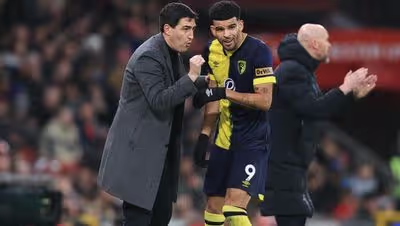
Why this matters
Bournemouth are no longer content to be a yo-yo survivor. Under Iraola they combine athletic intensity with on-ball audacity, creating a spectacle that forces traditional big clubs to adapt. That shift raises Bournemouth’s profile, increases the value of their academy and scouting model, and makes the club an attractive destination for emerging talent and managers alike.
Tactical identity: directness, intensity and joy
Iraola’s Athletic Bilbao roots show in Bournemouth’s use of width and direct transitions, but his teams are less dogmatic than caricatures suggest. They press aggressively, sprint into half-spaces and attack with tempo. The payoff is a side that can expose anxiety in teams that rely on positional control — Arsenal on that Emirates night being a prime example.
Results that validate the approach
The early wobble in Iraola’s first nine games — a period that saw Bournemouth rooted near the bottom — gave way to a run that rescued the season: a key win over Burnley, a humbling 6-1 at Manchester City, then a bounce-back 2-0 over Newcastle and a seven-game unbeaten streak. Those swings underline both the volatility and the upside of his model: inconsistent across a full season, but lethal in the right match-ups.
From player sales to a sustainable model
Bournemouth’s on-field style has translated into transfer markets paying up. Over recent windows the club has generated roughly £300m in sales by developing players who fit high-press, high-intensity systems — strikers, defenders and dynamic wide players who appeal to Champions League clubs. That revenue stream reduces reliance on single benefactors and gives the board leverage when hiring a successor.
What the windfall means
The money allows Bournemouth to reinvest in scouting, coaching and infrastructure while maintaining competitiveness. It also positions them alongside Brighton and Brentford as mid-table clubs that profit from smart recruitment and coaching continuity. The challenge is replacing Iraola’s motivational touch and tactical clarity without diluting the identity he installed.
Succession: continuity or reset?
Iraola is expected to leave this summer for a bigger project; his stock has risen after wins at Old Trafford and elsewhere. The sensible path for Bournemouth is continuity: another high-intensity coach who can work the same recruitment channels and keep the club’s upward trajectory. Target profiles include managers comfortable with pressing, quick transitions and youth development.
Risks and opportunities ahead
Replacing a figure like Iraola is never seamless. The biggest risk is reverting to conservative management that sacrifices the very style that created the club’s current market value and identity. The opportunity is to cement a new normal: a mid-table Premier League club that regularly beats top opposition, develops talent and sells at a premium.
Legacy and wider Premier League impact
Iraola’s tenure has done more than lift Bournemouth up the table; it has nudged the league’s tactical conversation. His success reinforces the viability of athletic, direct football against technically superior opponents and pressures traditional powers to be less risk-averse. For Bournemouth, the era after Eddie Howe is no longer nostalgia — it is a fresh, distinct chapter driven by identity, development and ambition.
Bottom line
Bournemouth now have a clear blueprint: high-intensity football that produces results and market-value players. The next manager must safeguard that ecosystem. If they do, the Cherries will remain a disruptive force; if they don’t, the club risks reverting to the caution that once defined them.
Five observations from Bayern Munich’s 4-3 win against Real Madrid
Either way, Iraola’s imprint has already reshaped Bournemouth’s future.
 The Guardian